
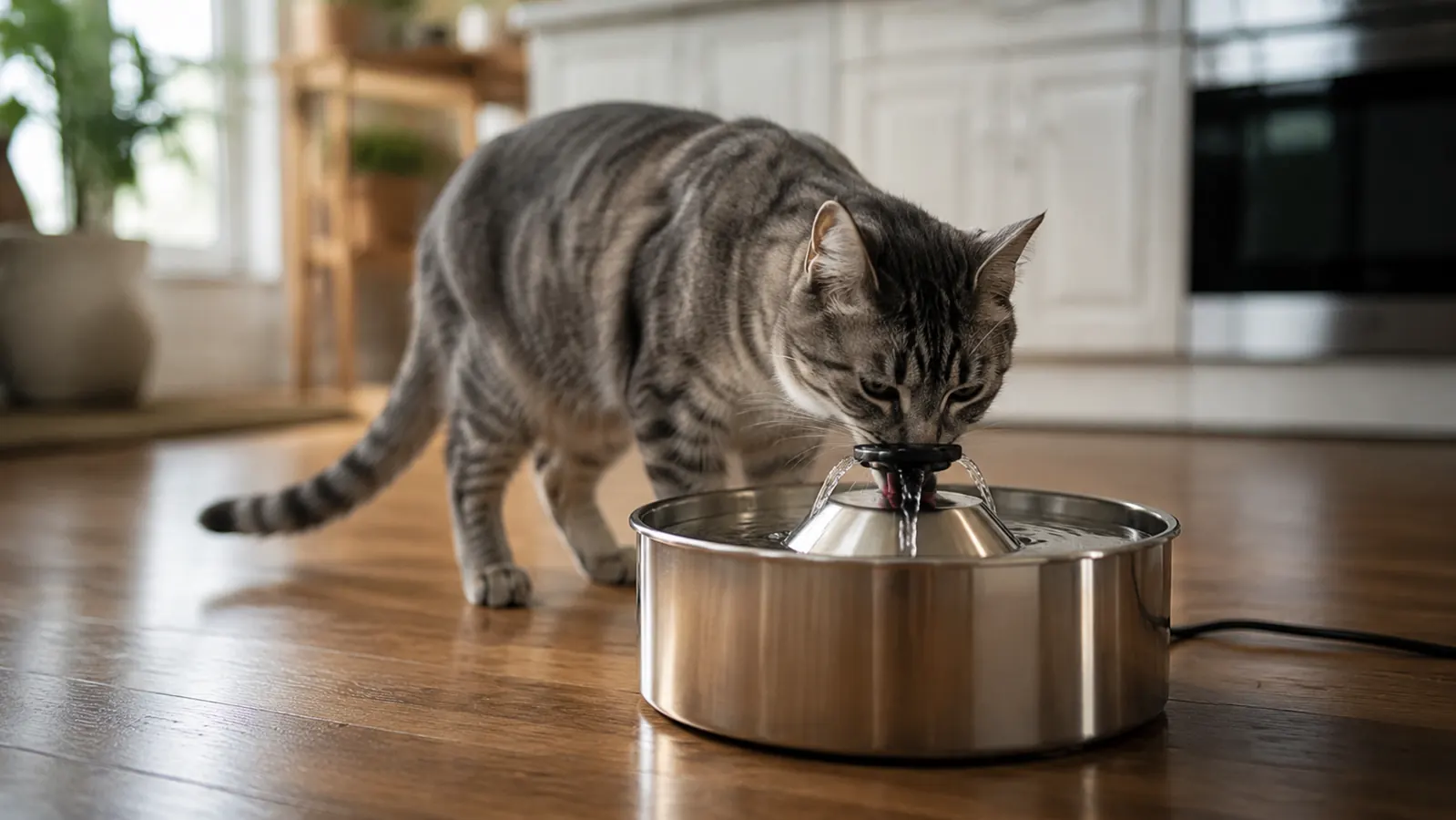
I grew up with dogs, so it took me a year of living with cats to realize I was measuring them against the wrong animals. Dogs hit the water bowl like it's the best ten seconds of their afternoon and walk away with wet chins. Cats drink the way they do everything else: quietly, a few laps at a time, and almost always after you've stopped watching. So I was genuinely stunned the first time our vet ran a hand down Mabel's back and told me her kidneys were working harder than he liked. She was eleven, she was fine, and she was not drinking nearly enough for a cat her age. I had no idea.
Here's the thing nobody tells you until you're sitting in the exam room: cats are built to get water from their food, not from their bowl. Their wild ancestors came out of deserts and drank mostly through prey, so the thirst reflex never developed the way it did in dogs. A dog drinks because its body asks for it. A cat drinks because it happens to notice the water. My whole fix for that, in the end, was a Wonder Creature fountain, and I'll show you the exact order I worked through with my three, Mabel, Pip, and June.
Your cat won't drink more because you ask. It will drink more because the water moves.
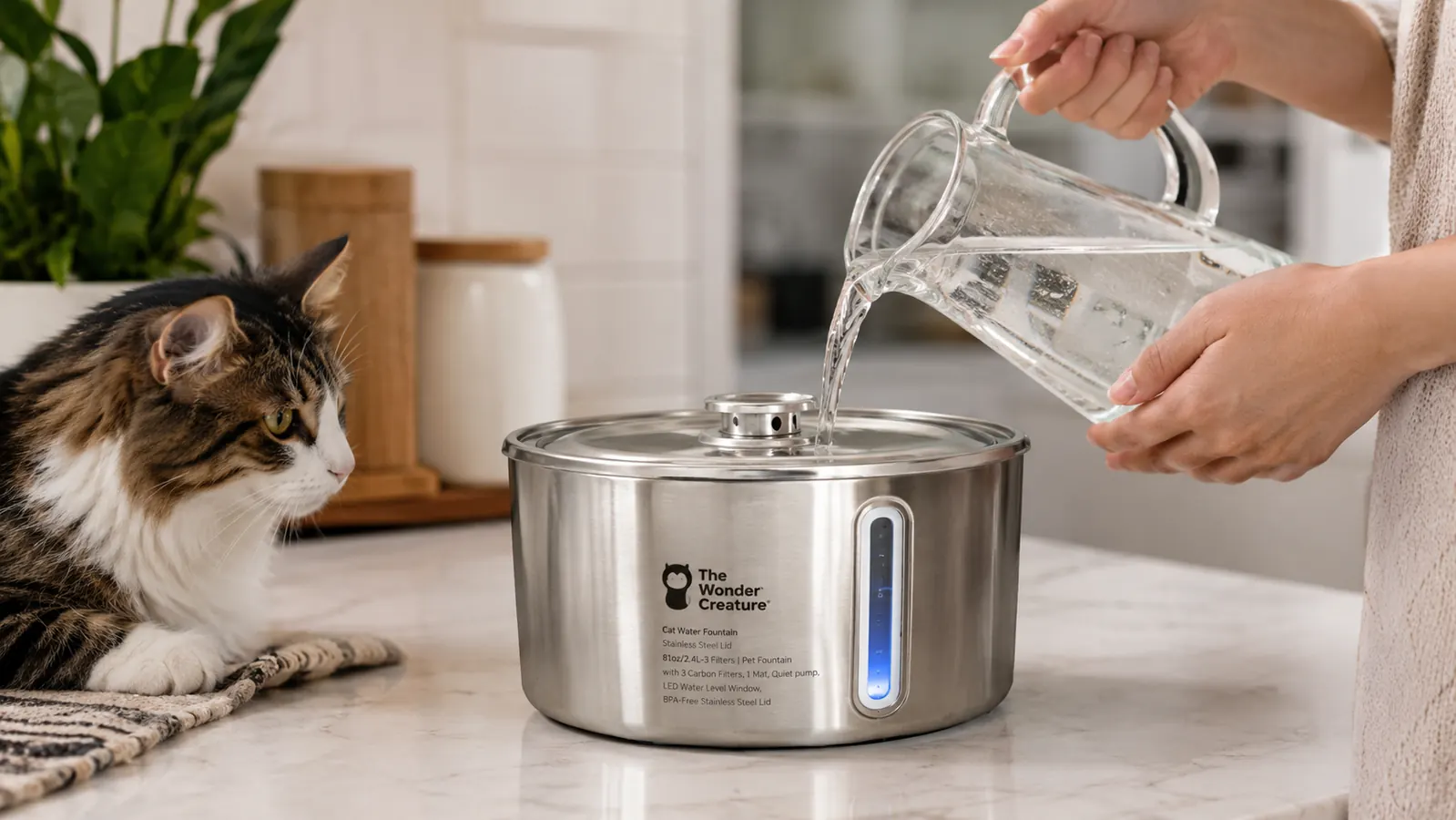
The day I stopped offering still water and started offering moving water, everything shifted. I use the Wonder Creature fountain with the stainless steel lid because it holds 2.4 liters, sits quiet enough to live beside the couch, and the LED window means I can tell from across the room when it needs topping off.
Amazon Check Today's Price on Amazon →Step 1: Fix the bowl, because most bowls do the opposite of helping
Before I bought a single thing, I did one free test. I filled a wide, shallow ceramic dish, the kind you would serve soup in, and set it where Mabel already drank. Within two days she was visiting it more often, because her whiskers had been brushing the sides of the old plastic bowl, and a cat's whiskers are roughly as sensitive as your fingertips. A bowl that is too deep or too narrow reads to a cat as an obstacle, not a drink.
Drop plastic from the rotation entirely. It scratches, it holds smells no matter how well you wash it, and a faint stale odor is exactly what tells a cat the water is old. Go with glass, ceramic, or stainless steel, wide and shallow, and rinse it every single day. I can't smell anything when I hold the bowl to my face, but Mabel can smell what my tap did on Tuesday.
Step 2: Move the water away from their food, and away from the litter box
Here's the dog-person correction. We put the dog's water right next to his food bowl, because that's where a dog wants it. Cats read still water near food the other way around: in the wild, a kill near a watering hole is how you poison the water. To a cat, a bowl parked an arm's length from the kibble might as well have kibble swimming in it.
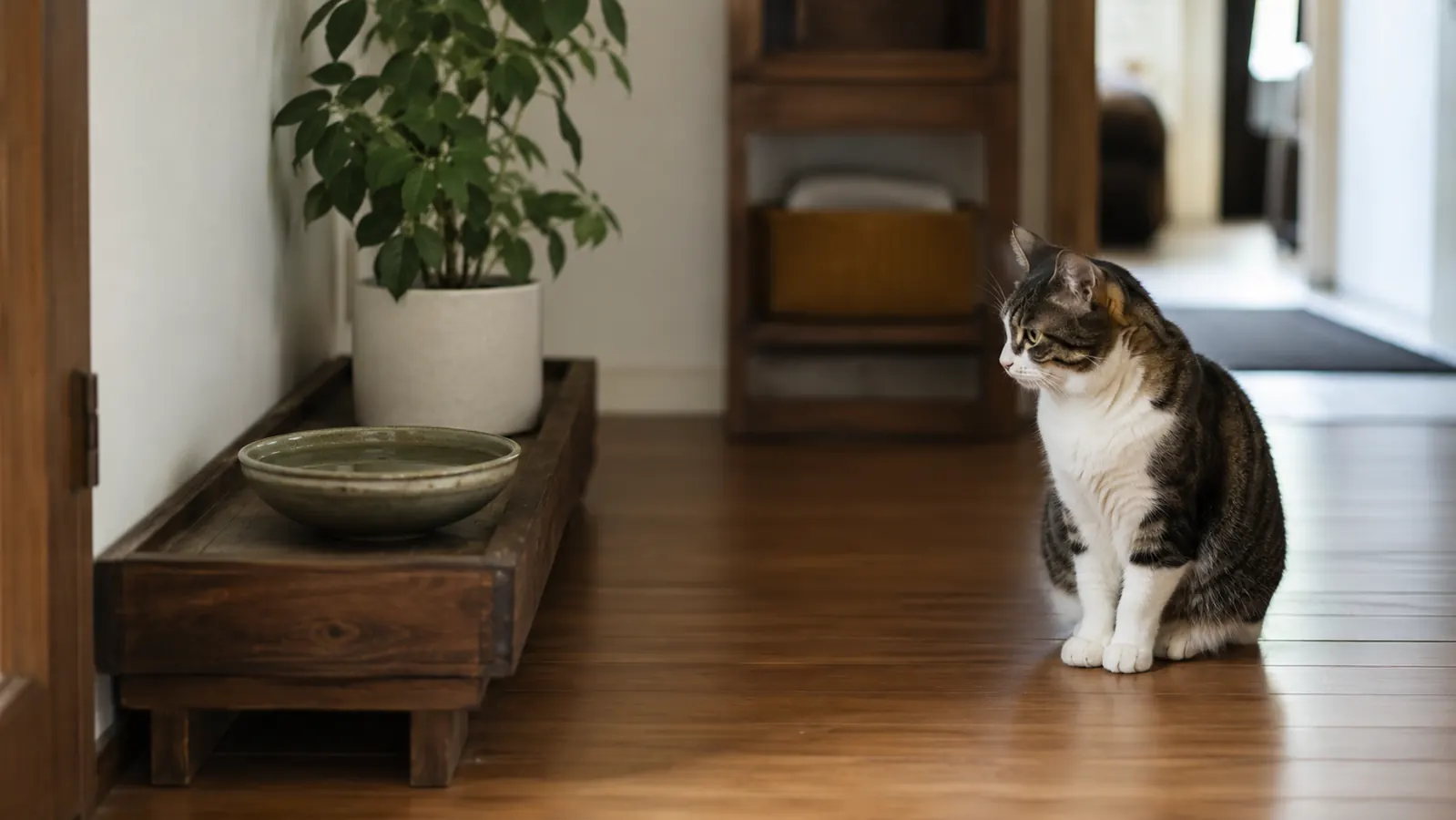
So I moved Mabel's bowl across the kitchen to a low shelf in the hallway, and the second thing that happened is that Pip, who had never touched her own bowl, started using the hallway one. Cats who won't drink near food will happily drink around a corner. And keep everything away from the litter box, too. A cat won't drink near where it goes any more than you would eat in a restroom.
The other half of this step is simple math for multi-cat homes: one water station per cat plus one backup. With three cats I keep four stations now, the fountain, two wide bowls, and a glass on my nightstand that June acts like is hers alone. None of them goes anywhere near a food dish.
One more placement note, free of charge: cats like water that feels defensible. A bowl shoved against a wall in an open room leaves their back exposed, which is why skittish cats drink less where everyone eats. Mine finally settled into a spot on a hallway shelf with a clear view of both doors, and that is the station all three use the most. Give a shy cat a way to see what is coming and she will drink a whole lot more.
Step 3: Give them moving water. This is the change that did the most
Running water is the oldest cat instinct there is. A moving stream reads as safe, because it can't be stale. A still bowl reads as a gamble. I confirmed it for free before spending anything: I left the bathroom faucet on a slow drip for an afternoon, and all three cats lined up for it like it was the most interesting thing in the house. That sold me on the fountain.
I went through the cheap plastic fountains first and learned why the reviews warn about them. The pumps whine, the plastic picks up a smell that defeats the entire point, and one of mine stopped dead while I was out of town. What I landed on is the Wonder Creature, which fixes the two things that mattered to me: the surfaces that touch water are stainless steel, and the reservoir holds 2.4 liters, so three cats and a two-day weekend won't run it dry.
It ships with three carbon filters and a mat, and the quiet pump is the part my cats vote for. The LED water level window sits on the side of the reservoir, so I know from the couch when it's low instead of discovering an empty, humming tank on day three. Within about a week, Mabel was the first one at it every morning, which tells me more than my opinion ever could.
The one thing I'll be straight with you about is the upkeep. I take the Wonder Creature apart and wipe down the reservoir every other week, and I swap a filter roughly every four to six weeks depending on how hard the water is. It adds up to ten minutes with hot water, and it is not optional, because a fountain that runs dirty is worse than no fountain at all. The honest review I wrote digs into exactly how sticky that routine gets, no glossing over it.
Step 4: Make the water taste like water
You can't see what your tap water tastes like to a cat, and you never will. Between the chlorine and whatever lives in the pipes, a lot of cats are silently deciding between not thirsty and that tastes like a swimming pool. I switched to filtered water from a pitcher I keep on the counter, and I refill the fountain through that. It costs pennies and removes one more excuse.
Temperature matters too. I fill every station with room temperature water, never fridge-cold. Cold shocks the nose and tells a cat the water is off; room temperature smells like a creek. And soap is the hidden culprit nobody mentions. A bowl rinsed with dish soap and then inadequately rinsed leaves a smear of scent that I can't smell and a cat absolutely can. Wash bowls with hot water, a whisper of soap, and a very thorough rinse.
Even with the fountain, I run a full swap of water every couple of days. A full 2.4 liter reservoir looks like plenty, but cats still prefer freshly topped water, and the biggest laps of the day are the first ones after I pour. If you watch closely you will see the pattern for yourself: cats drink hardest when the water is new. Use that. I do my topping off right before bed, because the quietest drinking of the day happens in the dark.
Step 5: Put the water in their food
This is the fastest single change, and I do it every single night. Wet food is already somewhere around seventy to eighty percent water, so shifting more of the day from kibble to wet food moves the numbers fast. Mabel gets a quarter can of wet food warmed for ten seconds so it smells like dinner, and she licks the dish clean where she used to leave half her kibble. It is remarkable what a little heat does to a cat's appetite for water.
For kibble meals, I add a splash of warm water and let it sit for a minute, turning it into something closer to a stew and adding a few tablespoons of water to every meal without her noticing. In summer I freeze low-sodium chicken broth into little cubes, and one in a water bowl on a hot afternoon is the closest I've seen to a treat that also hydrates. Plain broth only, no seasoning, no onion, no garlic. Read the label, because cheap broths sneak in ingredients you do not want in a cat.
And here's the boundary I keep in mind: water intake is not a substitute for a vet. The reason this whole routine started was bloodwork. If your cat stops drinking suddenly, drops weight, or starts hiding, that is a vet conversation, not a new fountain conversation. This routine is for the everyday version of not drinking enough, the kind that creeps up on an older cat over years.
What Else Helps
A few odds and ends round out the routine. Ice cubes in the summer bowl get more licks than you'd expect. A fountain on a timer, running at sunrise and sunset, lines up with when cats are most active and keeps the pump from running all night. And the dehydration check I use before I panic: gently pinch the skin at the shoulders, and it should spring back within a second or two. Sunken eyes, a cat who stops grooming, or a cat hiding are the signs to act on, not to research first.
I'll also tell you what I'd skip. Flavored water additives and broth powders promise the world, and cats do lap them up, but a cat who only drinks flavored water has to relearn plain water all over again. Nudging the habit with placement and moving water is cleaner than making them dependent on a flavor. Cats are animals with real instincts, not small dogs who will do what you ask. Your job is to set the environment and let them decide. If you want the deeper argument for why running water beats a bowl, I laid out all the reasons here, and if you want the unfiltered truth about cleaning and noise before you buy one, the honest review does not sugarcoat it.
Finally, the two gauges I actually trust. First, the litter clumps. When Mabel's turned small and crumbly earlier this year, that was my first quiet signal that her water was low, and now they are back to full and solid. Second, the annual bloodwork for any cat over seven. Kidneys creeping up is exactly how this started for us, and a simple yearly panel catches it while it is still a habit change and not a treatment. Cats hide decline outrageously well. The test doesn't lie.
Ten days after the fountain moved to the hallway, Mabel was drinking twice as much, and the vet saw it in her numbers before I said a word.
Tonight's homework is free: warm water in the dinner bowl.
Do that tonight, move a bowl across the house tomorrow, and think about the fountain by the weekend. It's the cheapest insurance for years of quiet, healthy kidneys I've found.
Amazon Check Today's Price on Amazon →