
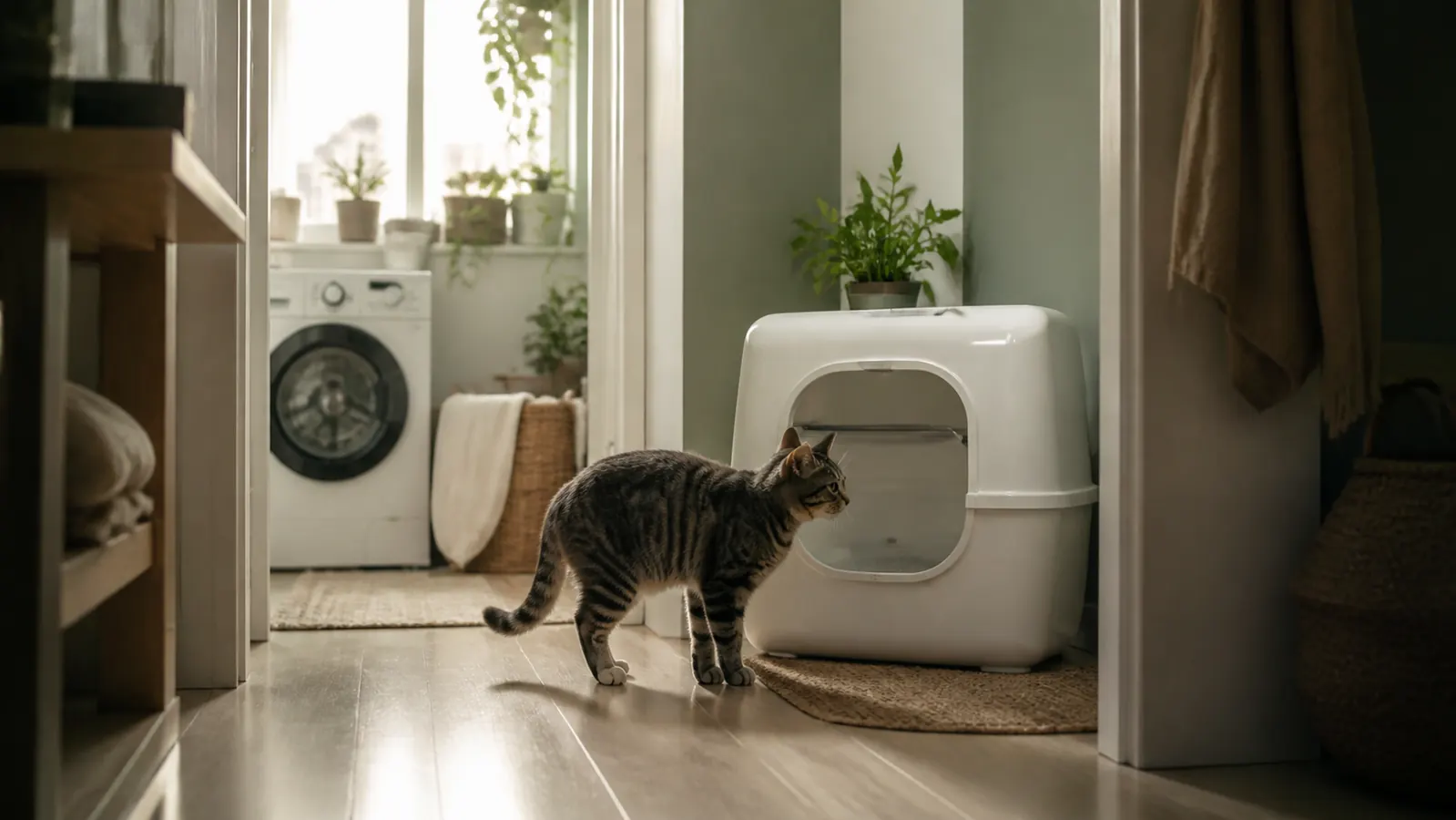
Six months ago our apartment smelled like a farm stand in August and I was fresh out of ideas. That is not dramatic, it is just what happens when you share a small two-bedroom with three cats and nobody ever hands you the rule: in a house with dogs the smell stays in the yard, and in a house with cats the smell moves into your hallway. I grew up with dogs, so I learned the litter version of that lesson the hard way. We tried an open tray, then two open trays, then scented litter that made everything worse, then a box of deodorizer crystals that Penny, my eleven-year-old tuxedo, promptly started sleeping on like it was a tiny mattress.
In January I finally gave up on open trays and switched our main box to the hooded, enclosed cat litter box from Amazon Basics, the No-Mess one with the swinging door. Not an automatic robot, not a fancy gadget, just a durable hood with a charcoal filter, a door that swings both ways, and a ring on the side that holds a grocery bag while you scoop. Six months of daily scooping later, I have very specific opinions, a guest test I actually ran, and one honest warning about who should not buy this thing. Here is the whole story.
The Quick Verdict
The best simple fix I found for a small apartment full of cats. Real odor control, much less scatter, and a box all three cats will use, as long as you scoop daily and take the door off for the picky one.
Amazon Check Today's Price →The Box That Ended Our Hallway Smell
If you have been playing whack-a-mole with scented litter and deodorizer crystals, this is the straightforward fix. Six months of daily use with three cats says it holds up. Check today's price on Amazon and see if it earns a spot in your hallway.
Amazon Check Today's Price on Amazon →How I've Used It
Setup took thirty seconds out of the box. The hood clips onto the base, the charcoal filter sits in the lid, and the door snaps into the frame. I put it in the mudroom nook off the kitchen where the open tray used to live, filled it with the same unscented clumping litter we already used, and watched the negotiation begin. Juno, our five-year-old orange tabby who believes he is in charge, walked in within the hour and used it like he had invented the concept. Biscuit, the three-year-old calico, turned the swinging door into a game before she ever used it for its actual purpose.
Penny, our eleven-year-old tuxedo, is the one who refused to be rushed. She sniffed the door, sat down, and gave me a look that said the apartment was under new management, and she held out for two days before she trusted it. That hesitation is the single most important thing to know about this box, and I will get to it in the tradeoff section. Once the door was accepted, I settled into a routine I could actually keep: scoop every morning into a grocery bag clipped to the side ring, wipe the rim once a week, swap the charcoal filter every four weeks, and scrub the base and hood in the tub once a month.
For the record, that is more upkeep than an open tray asks for. Nothing about an enclosed box lets you off the hook for scooping. What it changes is what happens to the smell between scoops, which in a two-bedroom is the entire problem.
The No-Mess name does a lot of work and it mostly earns it. Amazon Basics sized this box for a full-size cat, not just a kitten, which matters because our orange tabby Juno is not a small boy. The raised lip is low enough that Penny steps over it without a fuss, and the interior is roomy enough that Biscuit can turn around without her tail brushing the walls. On paper that all reads like box trivia, but I have owned a supposedly cat-sized tray that a cat would only use sideways, and this is not one of those.
What Six Months of Daily Scooping Taught Me
The odor control is not a trick of the nose. The charcoal filter in the lid plus the sealed hood genuinely hold the smell, and I know because I stopped trusting my own nose and started trusting my upstairs neighbor. She used to ask, at least once a week, what we were cooking. It took me a month to realize she was really asking what we were hiding. She has not asked since February.
Second, the filter is the hidden chore, the quiet contract. It is not expensive, but it is a you-must-remember to replace it. Around week five the smell creeps back in. Not a disaster, just a hint, and that is the filter telling you it retired. I marked a date on the kitchen calendar, which is exactly the kind of low-effort system that only works if you actually write it down.
Third, and the one I did not expect, is how the daily chore changed. With an open tray I scooped resentfully, in a hurry, holding my breath. With this box I scoop into the bag ring and I am done in ninety seconds, no breath-holding, no trip to the bin, and the daily job stopped feeling like a job. That is a real quality-of-life change that no spec sheet will ever tell you about.
One more thing I want to be honest about, because it surprised me: the box survived six months of daily use without loosening, wobbling, or falling apart, and that is not nothing. The hood clips stayed snug, the door hinge never cracked, and the bag ring held up to daily tugging. I have bought cheap bins that split in a season, and the build quality here is the quiet reason I would reach for Amazon Basics again without a second thought.
The upstairs neighbor stopped asking what we were cooking. Honestly, that is the whole review.
The Monthly Deep Clean
Here is the part the marketing photos skip. The hooded design keeps smell in, which means every so often it also keeps the inside of the box in a climate that deserves a deep scrub. Once a month I take the whole thing to the tub: hood off, base out, old filter in the trash, and a warm soapy wash plus a rinse down the drain. It runs about twenty minutes start to finish, and I time it with my Sunday baking, because both are chores I would rather lump together than face alone.
The good news is that the plastic wipes clean easily and does not hold the smell once rinsed. The honest news is that a plastic base shows claw scratches over time, and nothing about that is a defect, it is just what happens when cats are cats. If a spotless glossy box is a dealbreaker for you, this enclosed plastic box from Amazon Basics will probably disappoint you more than an open tray would.
Where Amazon Basics Actually Earns It
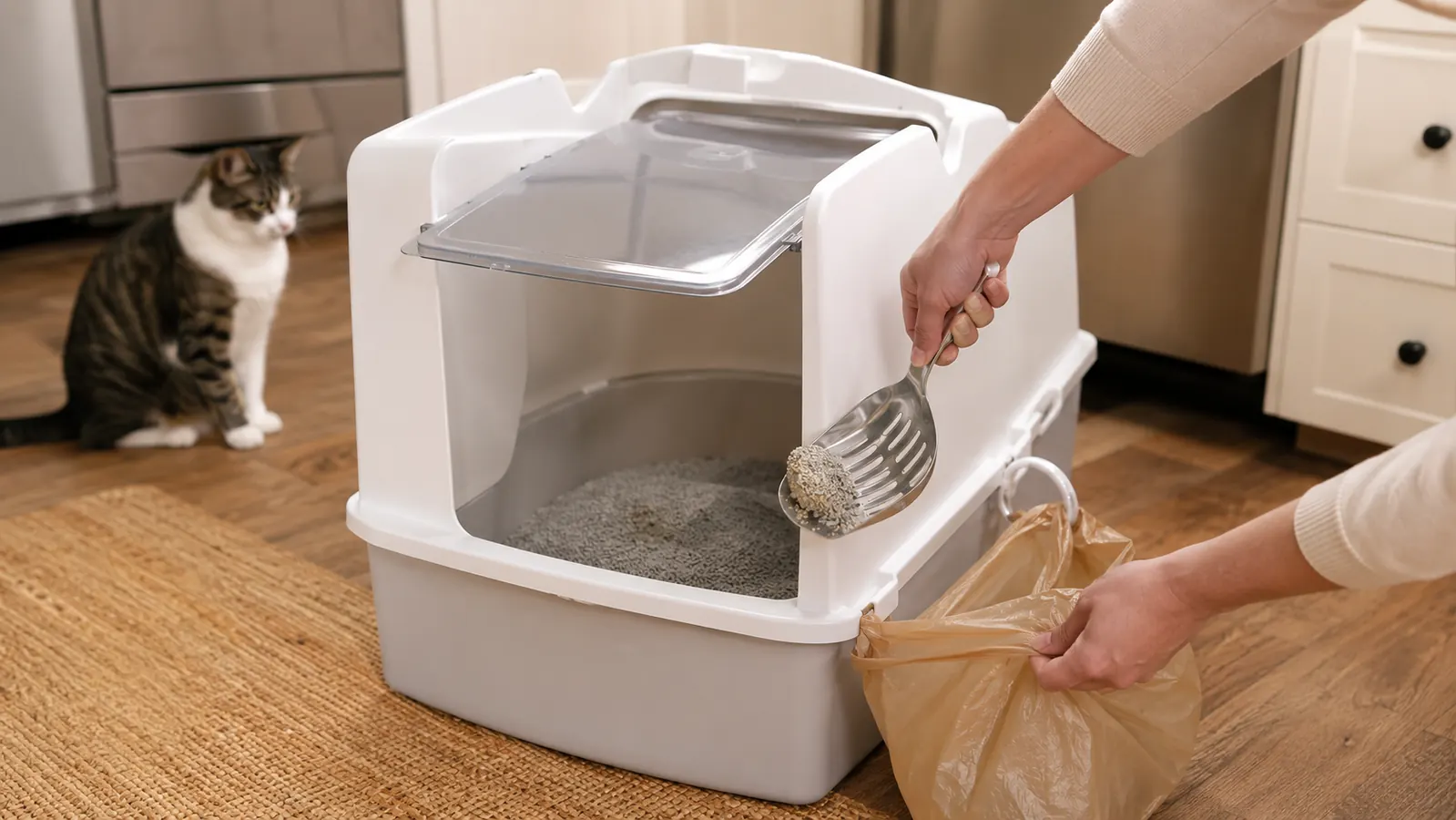
The side bag ring is the quiet genius. It folds out and holds an ordinary grocery bag open at the right height, so scooping is scoop and drop, and the bag comes off and ties shut with the litter already inside. I was skeptical of a plastic ring being anyone's favorite feature, but it is genuinely the thing I reach for every single day.
The hood pivots up and clips open, so I can see the entire base when I clean, and it stays off my floor instead of dangling. The door swings both ways, in for the cat and out for the cat, and its real job is keeping litter inside and odor currents down. It also doubles as cat entertainment, which Biscuit treats as enrichment and I pretend not to encourage.
Tracking is better than an open tray, but it is not zero. Less litter hops the rim, and the hood traps a lot of the scatter near the box, but fine particles still ride out on paws and end up on the kitchen linoleum. We put a mat under the door side, which catches most of it. If your fantasy is a house with no litter granules on the floor, no enclosed box on earth will get you there.
The Tradeoffs Nobody Mentions at the Register
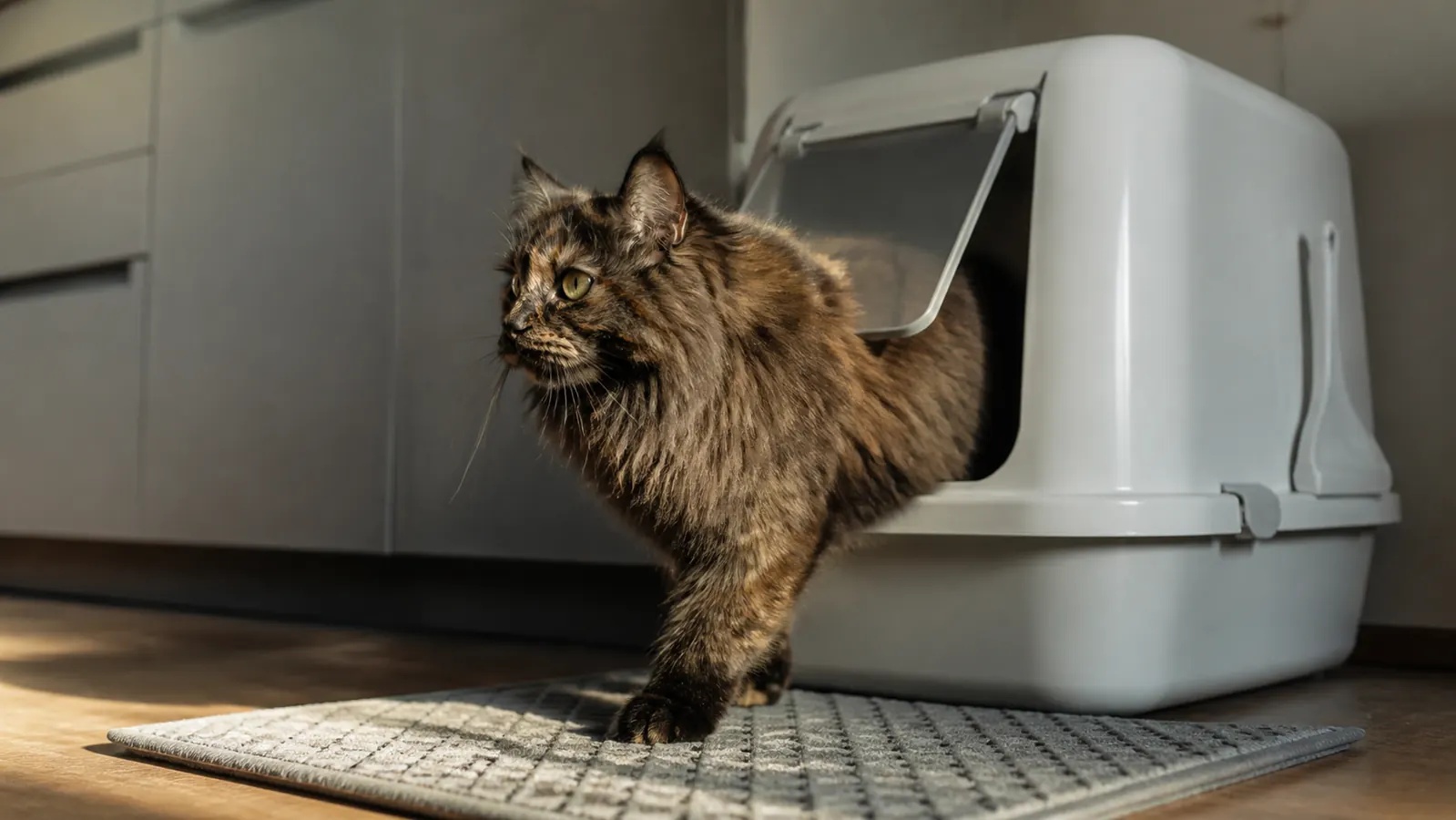
First and biggest: the swinging door is a genuine problem for nervous cats and for older cats with stiff joints. Penny, who is eleven, hissed at it every day for a week because she decided a door that moved on its own was not to be trusted. I took it off for a month, and that is the honest fix. The box works perfectly fine without the door, you just lose a little containment. If I had bought this for a skittish cat and refused to adapt, we would own an unused box and a cat who peed on the bath mat.
Second, an enclosed box concentrates whatever you fail to clean. Skip scooping for two days with an open tray and the whole room notices. With a hooded box, the smell builds up inside the hood and then releases all at once when the door swings, which is a worse experience and much harder to ignore. This box rewards a daily routine and punishes a lazy one, and nobody prints that on the carton.
Third, it is genuinely large. The base runs about two feet long, and the hood takes it taller than a shelf of canning jars, so it needs floor space in a way a corner tray does not. And with three cats I still keep a backup open tray in the laundry room, because the rule with cats is one box per cat plus one, and no single box, however well made, serves three cats alone. In our house this one comfortably handles two.
What Else We Tried Along the Way
The automatic self-cleaning litter boxes were the tempting road not taken, and I am glad we skipped them. A motor, a schedule, and electronics all living beside cat waste is a gimmick factory, the exact thing I walk past in stores. Penny would refuse anything that moves and whirs, and I have watched enough friends' robots eat their deposits to know those need their own full-time caretaker. I make my own bath salts and bake my bread from scratch, and I want my cat supplies to stay dumber than I am.
Scented litter and deodorizer crystals were the other dead end. They do not remove the smell, they argue with it, and you end up with a hallway that smells like a candle that lost a fight. The honest move for odor control is a sealed box, a filter, and daily scooping, and in a two-bedroom it beat open trays and deodorizers on every metric that matters. That is the long answer to the comparison I keep reaching for between an enclosed box and an open one.
I want to name one more comparison plainly, because it is the argument everyone has online. An open tray is smaller, period, and if your only objection is that you dislike the idea of cat waste under a hood, an open tray is the honest choice. But if your problem is a home that smells, or granules that travel to the far corners, this enclosed box answers the two complaints no open tray can. In a rental, that fixture settles itself fast.
What I Liked
- Charcoal filter with a sealed hood gives real, lasting odor control
- Swinging door cuts litter scatter and keeps dust down
- Side bag ring makes the daily scoop fast and keeps you away from the trash bin
- Hood pivots up for full-access cleaning of the whole base
- Simple construction with nothing mechanical to break
Where It Falls Short
- Swinging door spooks nervous and older cats until you take it off
- Hidden monthly filter replacement you have to remember
- Concentrates odor if you fall behind on scooping
- Large footprint that needs real floor space
- One box still does not serve three cats on its own
Who This Is For
If you live in an apartment, a condo, or any place where your hallway is also your guest hallway, an enclosed box is the single highest-leverage change you can make to your cat setup. It is for one and two cat households, for people who scoop daily anyway, and for homes where cleaning the box is one person's job instead of a vague shared idea. It is also for anyone whose friendly neighbor has started asking what smells so interesting, because that question needs to stop.
Who Should Skip It
Skip it if your cat is elderly with arthritis or any stiffness that makes stepping through a raised lip and a swinging door hard. Skip it if you have a cat who refuses enclosed spaces no matter how long you give them, because some cats will hold it out of sheer principle. And skip it if you are a three plus cat household hoping one magic box does everything, because no box replaces the per cat rule. You would want one of these per cat or two, which changes the whole plan.
Six Months In, We Are Not Going Back to an Open Tray
If your apartment still smells like a farm stand, the Amazon Basics No-Mess hooded box is the fix that actually held up for us. It is simple, it is well made, and unlike every gadget I researched, it cannot break. Check today's price on Amazon and see if it earns a spot in your hallway.
Amazon Check Today's Price on Amazon →