
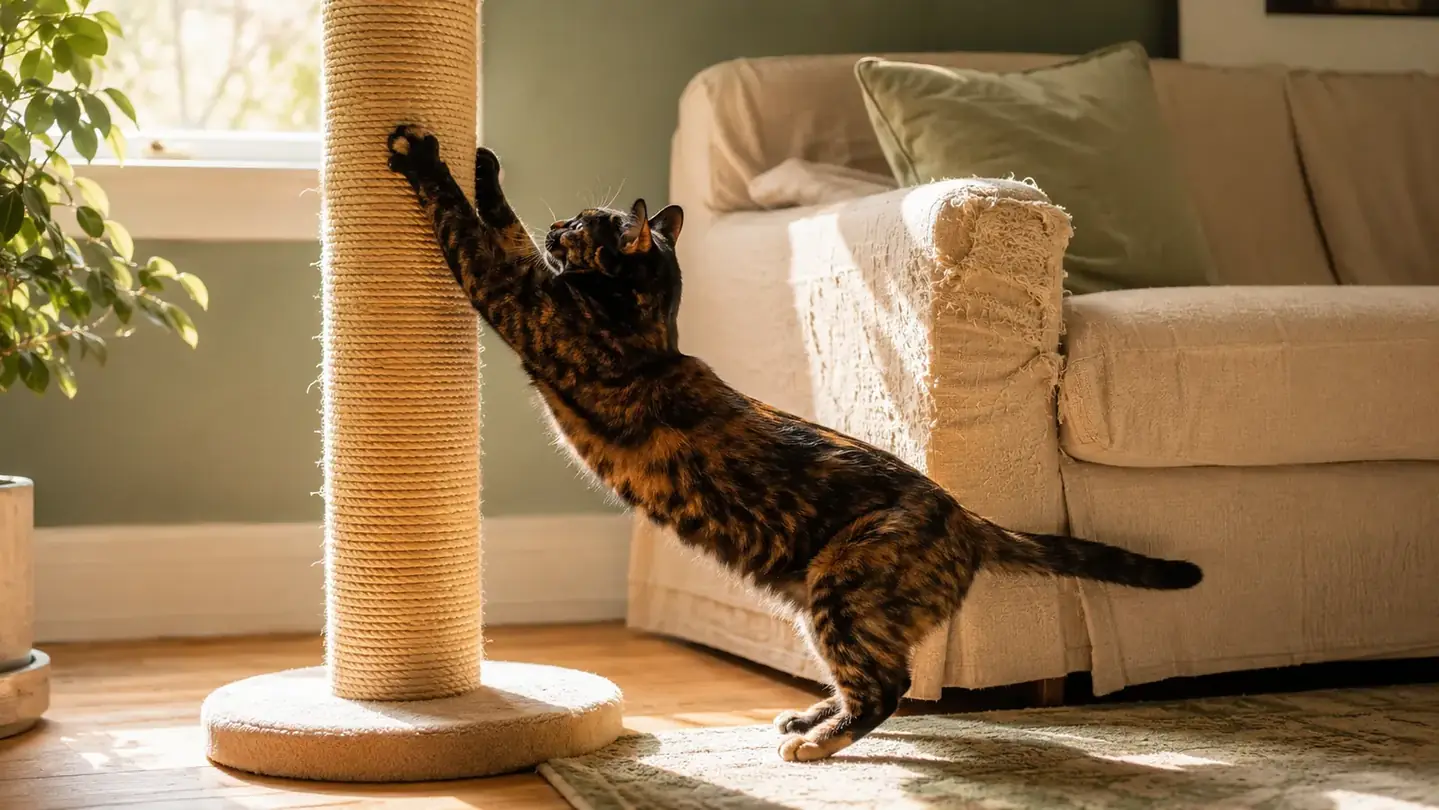
The afternoon I found the arm of our linen sofa shredded down to the wood, I did what most dog people do when a cat misbehaves: I went looking for something to scold. There was nothing to scold. Maple, our twelve-year-old tortoiseshell, had done exactly what a cat is supposed to do. She had claimed the best territory in the room in the most defensible way she knows. That lesson took me a while because I kept measuring cat behavior with a dog ruler, so let me save you the math. A cat does not scratch the furniture to be naughty. She scratches to peel off the worn outer sheath of her claws, to stretch the whole front of her body, and to leave a scent mark that says this spot is mine. The only real question is where you want all of that to happen, and that is the whole scratching post versus cat tree debate in one sentence.
So, scratching post or cat tree? Short version, and I am saying it up front because you deserve it before the table of numbers: for most homes, a good post wins. After five months of running the SmartCat post and a full cat tree side by side in one living room, the post is what keeps our couch alive. A cat tree is lovely, we own one now, but it solves a different problem. A post stops furniture damage in a way a tree mostly does not, because a tree's scratching surface is usually a thin layer of carpet a determined cat walks right past on her way to your chair. If I had to start over with three cats and one decision, I would buy the post first, every single time. Here is how I would break the choice down while you are staring at both in a shopping cart.
One honest note before the comparison, because it shapes everything that follows: these two things are not actually rivals. A scratching post and a cat tree are different tools for two different cat instincts. Scratching is a front-of-the-body behavior, a stretch and a rake and a territorial stamp. Climbing is a height behavior, a need to be above the room. The SmartCat post answers the first instinct completely and ignores the second. A cat tree answers the second and only half answers the first. Once you stop treating them as the same purchase, the choice stops being agonizing and becomes simple.
| Cat Scratching Post | Cat Tree | |
|---|---|---|
| Price | A fraction of what a tree costs | Three to five times the price of a post |
| Floor space | Fits in a 15-inch square | Needs 36 to 48 inches of wall or corner |
| Height for climbing | About 32 inches, no real climbing | 40 to 72 inches of platforms and perches |
| Scratching surface | Thick sisal on a solid wood core | Thin carpet and light sisal, shallower texture |
| Stability | Wide heavy base, no sway at full stretch | Varies a lot; tall trees rock unless anchored |
| Perch space | No perching at all | Multiple platforms for resting and observing |
| Assembly | None, it comes assembled | Thirty to sixty minutes with tools |
Where the SmartCat Post Wins
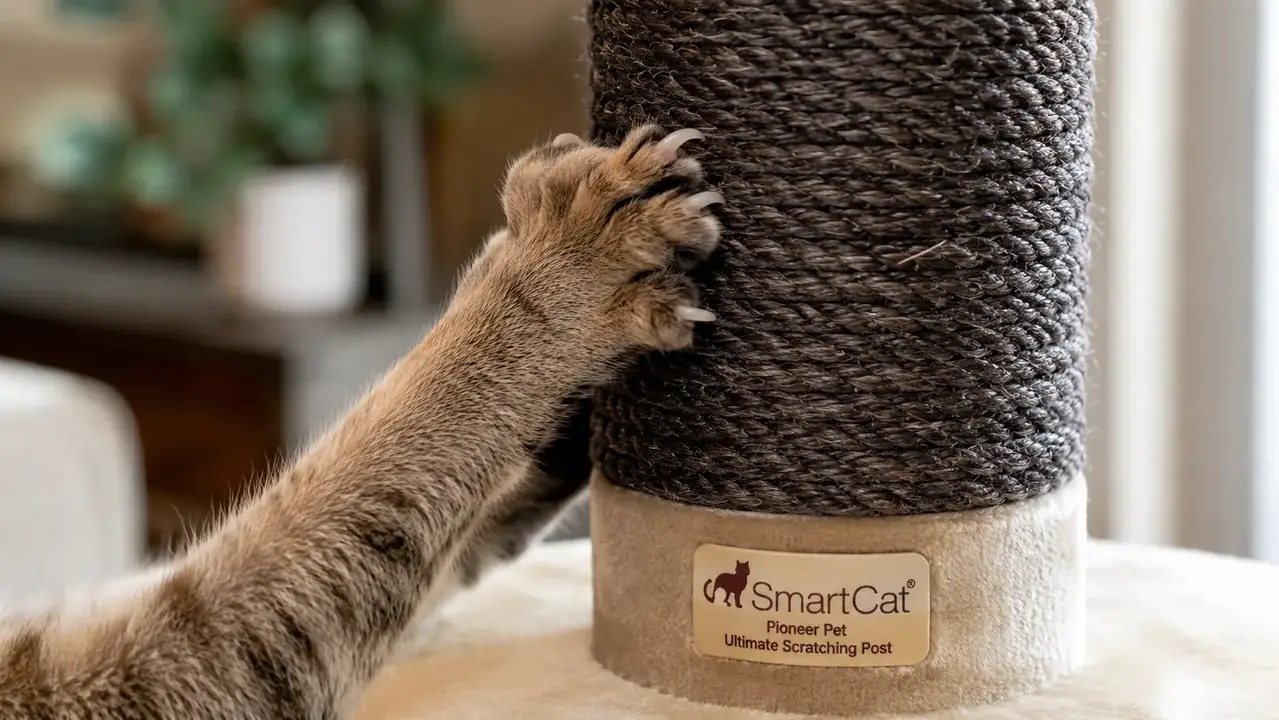
Cats judge scratching posts with the same standards we use on chairs: they check whether it rocks and whether it feels cheap. The SmartCat post passes on both counts. It is built around a solid wood core wrapped in thick sisal, and because it is low and the base is wide, it simply does not move. Milo, our fourteen-pound orange tabby, hooks his claws into the top edge and hangs his full weight off it like a rope climber, and the whole thing stays planted. That is the detail that actually decides everything. A wobbly post gets used once and then abandoned, because a cat reads instability as danger and takes the scratch to the nearest solid object, which is your couch. I watched that happen with a flimsy cardboard contraption we threw money at in our first year, and no amount of catnip ever brought it back.
The post also wins the placement argument, which is half the battle nobody mentions. You can slide it next to the couch, in a doorway, or in the hallway corner your cat already has her eye on, and put the scratching exactly where the damage happens. It costs a fraction of a tree, it comes assembled, and if it ever needs replacing you buy another thirty-inch post, not a small piece of household architecture. After Maple wrecked one sofa in a single season I was sure the answer had to be bigger, more impressive, some kind of monument to scratching. It was not. The fix was a solid, low, stable post placed precisely where she was already scratching. Cats are creatures of exact habit, they scratch the same two spots at the same two times a day, and a post you can position right there wins.
There is a second, quieter reason the post quietly wins for most people, and it is that its size forces good habits. A post is small enough to sit in the room you actually live in, so it gets used. A tree the size of a bookshelf tends to end up in the spare room, and a scratching surface out of sight is a scratching surface out of mind. Cats scratch where the family is. Keep the scratching within a few feet of the couch and the daily traffic of the household, not exiled to a corner where nobody and, more importantly, no cat spends time. The SmartCat post sits beside our sofa for no prettier reason than that the claws were already there.
The tree gave my cat a place to be high. The post saved the couch. Those are two different jobs, and until I separated them, neither one got done.
Where a Cat Tree Wins
The day the tree earned its keep in our house was the day Pip, our youngest, figured out the climb to the top perch and refused to come down for an hour. Cats are climbers, full stop. Height is safety to them, and an indoor cat has almost no way to act on that instinct in a normal living room. A tree gives a cat a patch of window at seven feet, a place to watch the birds and judge the street below, and a spot where she can feel like the tallest animal in the room. If you have ever watched the big cats pace a zoo enclosure, you know a climbing cat is a calmer cat. The tree is the closest most apartments come to giving that back, and it shows in Pip's mood on the days he uses it.
A tree also helps with the quiet politics of a multi-cat home. Three cats means somebody always wants the exact spot somebody else is sitting in, and the floor is where those negotiations go sideways. A tree multiplies the perches, so a shy cat can retreat upward, a senior like Maple can nap out of reach of the younger ones, and nobody has to like each other to share a room. And for anyone who grew up with dogs like I did, a tree is the only way a cat gets to be literally above the dog. You would be surprised how much tension evaporates when the cat can look down on the situation instead of defending the couch from it.
The honest tradeoff is that a tree earns its keep only if your cat is a climber, your floor is flat, and you are willing to maintain it. Tall trees rock on carpet, so we anchor ours to the baseboard with the wall strap. It is a ten-minute job that prevents the topple that would end the tree's life and your cat's trust, but it is a job. Weights also matter when you have a fourteen-pound boy who launches himself at the top platform like he is still a kitten, and a tree you have to rescue from the floor once a week is worse than no tree at all. Read the weight limits before you buy, and expect to retighten the screws every couple of months. That is upkeep, not failure, but it is real, and a post never asks for it.
If the furniture is the casualty, start here
The SmartCat post survived a stretching fourteen-pound tabby, a determined senior tortoiseshell, and a kitten learning to climb. It is the first thing I would buy again, even owning a tree.
Amazon Check Today's Price on Amazon →Who Should Buy Which
Buy a post first if the problem is furniture, if you live in an apartment, if you have one or two cats, or if your budget is tight. That is the whole description of a SmartCat-style post: affordable, stable, portable, and placed exactly where your cat already scratches. The post is the fix for the couch. A cat who already uses a good post is also a cat who will use a tree later, so you will not have wasted a penny on the wrong thing.
Add a tree when a cat starts climbing, when the kitten discovers the top of the bookshelf, when your cats have started squabbling over floor spots, or when you simply have the room and want to enrich the place. That is when a tree earns the larger footprint and the higher price. But be honest with yourself about what you are buying it for. If you buy a tree hoping it will stop the scratching, you will be disappointed, because the tree's thin covering is not what a determined cat wants to dig into. Keep a proper post near the furniture, and treat the tree as what it is: a perch and a playground that takes a little scratching on the side.
If you are stuck in the middle, there is a third path that worked for us before we owned a tree at all: a post plus one shelf or window perch that costs a fraction of a tree. The post handles the claws, the shelf handles the height calling, and you have covered both instincts for little money and no wobble. It is not as pretty as a tree, but it is a perfectly honest stopping point for a first-time cat owner trying to decide between the two.
What a Tree Still Can't Be
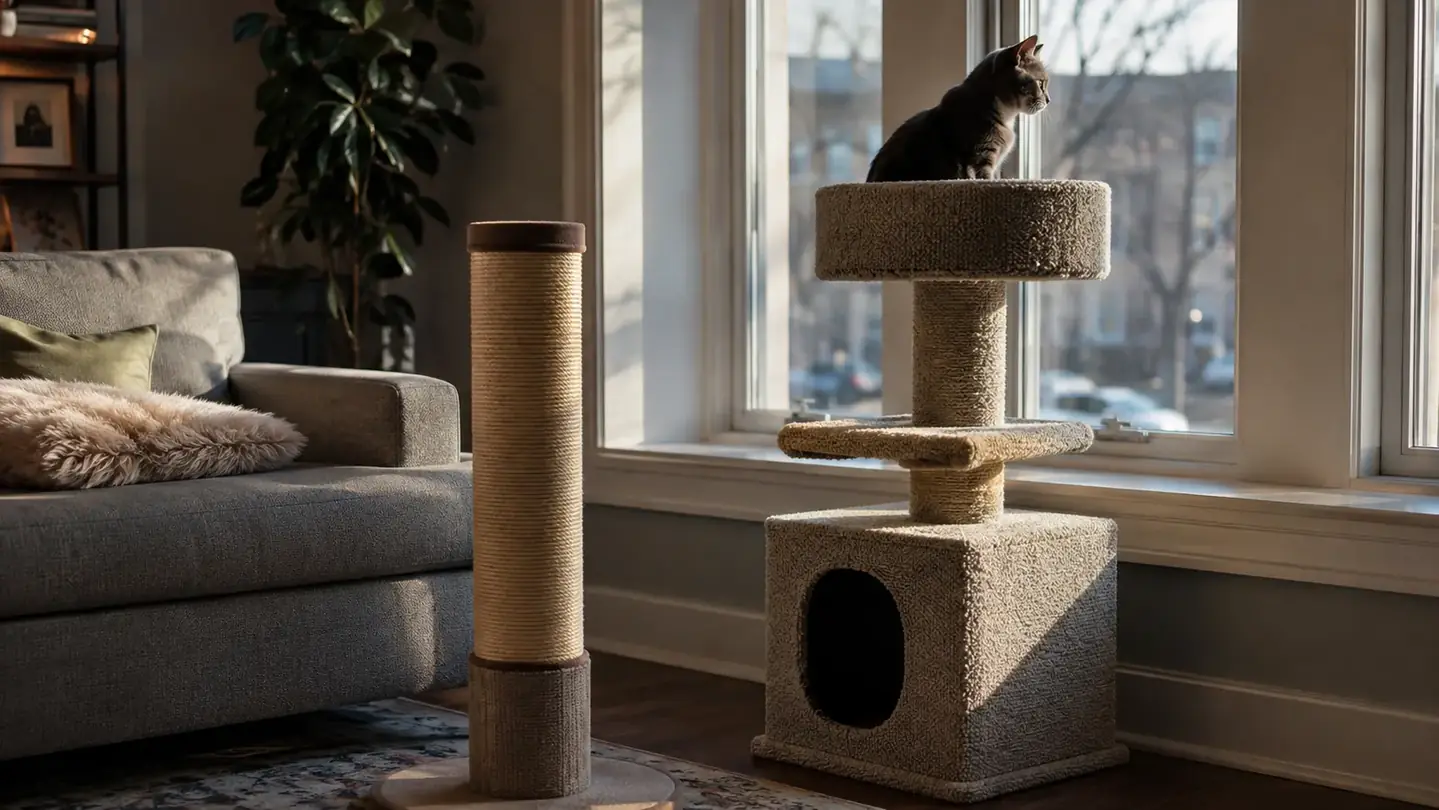
I want to say the thing nobody puts in the brochure, because it is the reason I keep coming back to the post. A cat tree, even a good one, is not a replacement for a proper scratching surface. The carpet and light sisal on most trees feel wrong to a cat who has felt real sisal, and more importantly a tree's perch does not give the full front-body stretch a cat gets from a tall vertical column. Watch your cat on a tree sometime: she scratches the trunk half-heartedly, then jumps up and uses the carpeted platform, which means her claws are not being maintained in the way they need. That is why our tree sits in the window bay and the SmartCat post stands by the couch. The tree is enrichment, the post is claw care, and they do not trade places.
The Bottom Line
We own both now, and I would not sell either, but they earn their keep in different rooms. The SmartCat post sits by the couch where the damage used to happen and does the daily job. The tree stands in the window bay and keeps the kitten high and busy. If you can only choose one, choose the post. It protects the furniture, it fits anywhere, it is cheaper, and a cat that scratches a solid sisal post will happily use a tree later. Most cats eventually want the height anyway, that instinct does not go away. But the scratching comes first, and the scratching is what saves your sofa.
Start with the post, add the tree later
The same SmartCat post that held up under daily use in a three-cat home is the one on this page. Check the current price, the height, and the sisal gauge for yourself.
Amazon Check Today's Price on Amazon →