
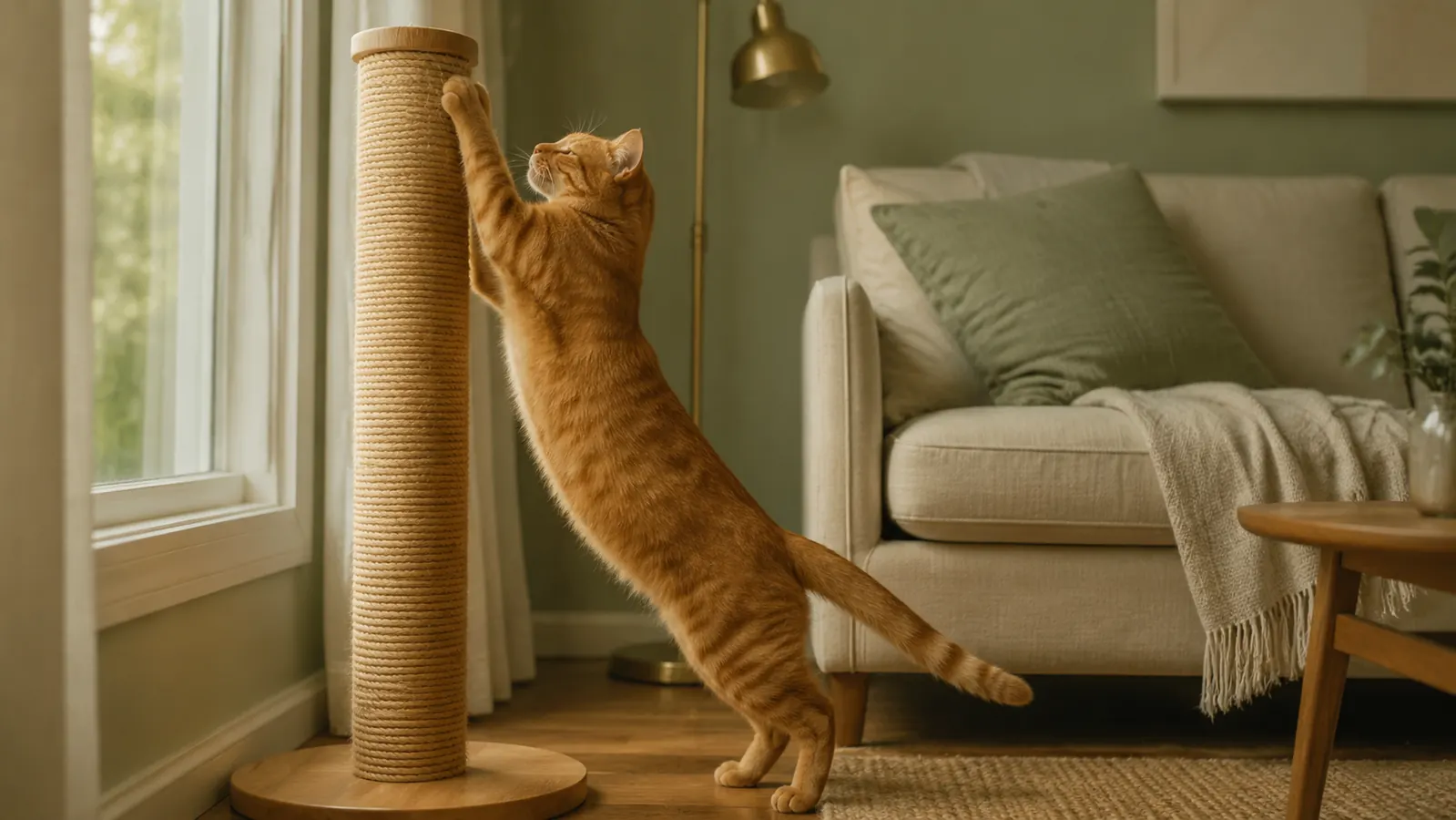
There comes a moment in every cat household when you stop, look at the arm of your couch, and realize it has started to look like a rope bridge after a storm. Ours came last February. The three-year-old IKEA couch was suddenly wearing a second sleeve of pulled threads, and I finally stopped blaming the cats and started asking what scratching is actually for. I grew up with dogs, so my first instinct was discipline, the way you teach a puppy not to chew the table leg. Cats do not do discipline. They do instincts, and for months I had been fighting the instinct instead of giving it a home.
In early February I bought the SmartCat Ultimate Scratching Post, a 32-inch column of sisal sitting on a solid natural wood base, and it has now survived six months of daily use from three very different cats. I write about cat gear the way I bake: I start simple, I watch what works, and I do not trust a claim until it has been through my own kitchen a few dozen times. This is the long version of that experiment: what held up, what I end up explaining to guests, and the one thing I wish someone had told me before I carried it up the stairs.
The Quick Verdict
A tall, rock-solid sisal post that every cat in the house actually uses, including our eleven-year-old tuxedo who trusts nothing. Six months of daily scratching, and it has never tipped, never shed its rope, and the couch has been left alone since the day it arrived.
Amazon Check Today's Price →The Post That Gave Our Couch a Second Life
If your furniture is running a yarn deficit and the flat cardboard scratchers have been retired to the yard, this is the tall, stable fix. Six months with three cats says it earns its corner. Check today's price on Amazon and see if it belongs next to your couch too.
Amazon Check Today's Price on Amazon →How I've Used It
It came out of the box nearly finished. The post is already seated in the solid wood base, no tools, no drawer full of leftover screws, which is my favorite kind of assembly. I carried it to the corner of the living room right next to the couch, because cats scratch where they already stretch, and I was not about to ask three cats to learn a brand new habit in a strange corner of the room.
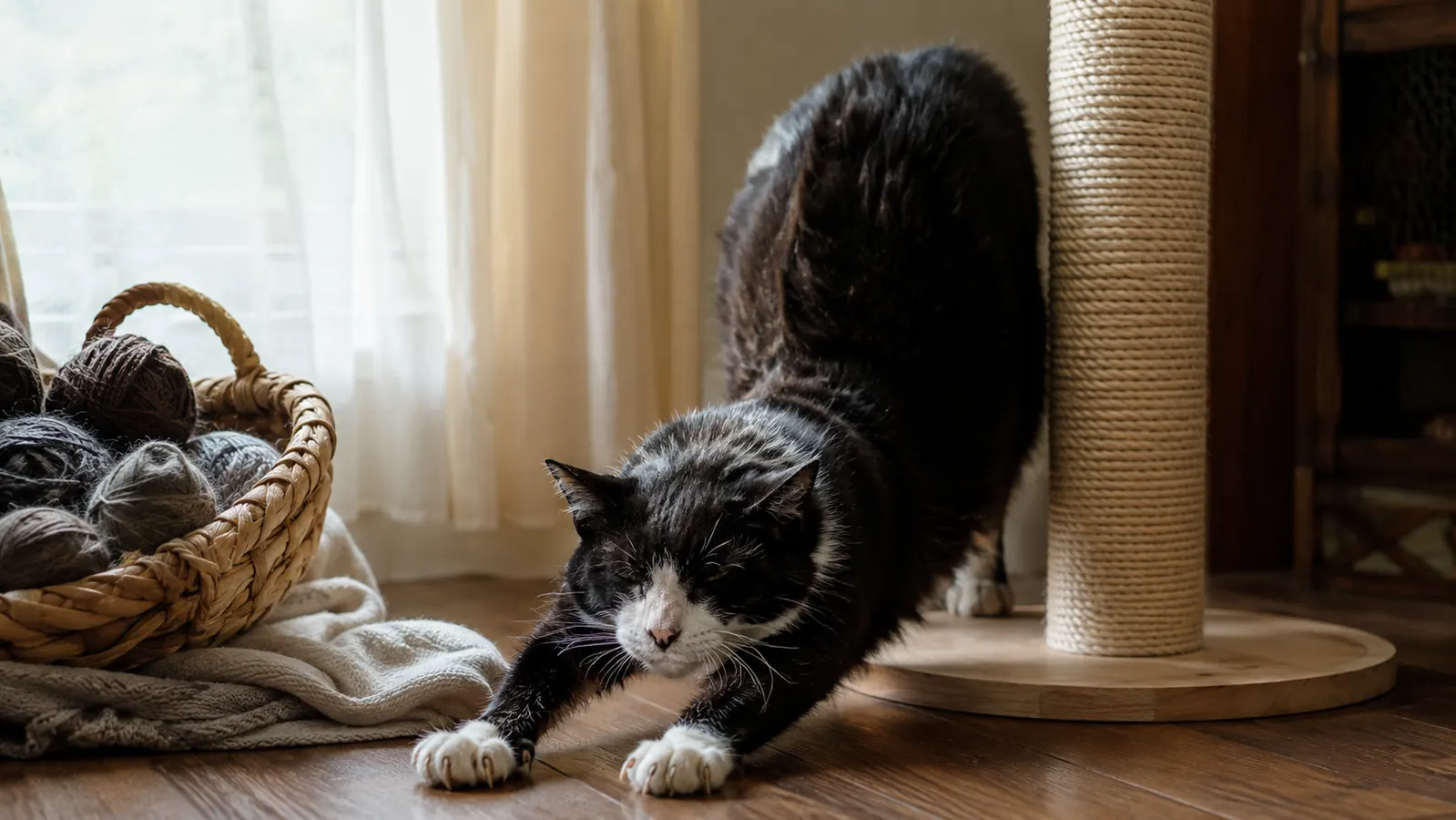
Juno, our five-year-old orange tabby who runs the household, claimed it within the hour. He runs the full ritual: sniff the base, hook the claws, and pull a stretch that reaches all the way up the 32-inch post. Biscuit, the three-year-old calico, uses it as the first act of her morning before breakfast. Penny, our eleven-year-old tuxedo, held out for a week, circling it the way she circles anything new, and now she would list it as one of her favorite three places in the house. Getting three cats of three very different ages to agree on any one thing is not normal, and they all agreed on this. There is a small territorial dance every morning, with Juno stretching while Biscuit waits her turn and Penny supervises from the couch cushions, but they all use the same post, which is the part I genuinely did not expect.
Maintenance is close to nothing, which is a sentence I do not get to write often as someone who keeps a sourdough and a bath salts shelf. Sisal sheds a little dust for the first couple of weeks, and then it stops. Six months in, the rope is worn smooth where it gets used hardest, around mid-height where all three cats dig in, but there is no fraying, no unraveling, and no green fiber on the rug. It is the lowest-maintenance thing I own, and I mean that in the best possible way.
Why a Tall Post Beats a Cardboard Scratcher
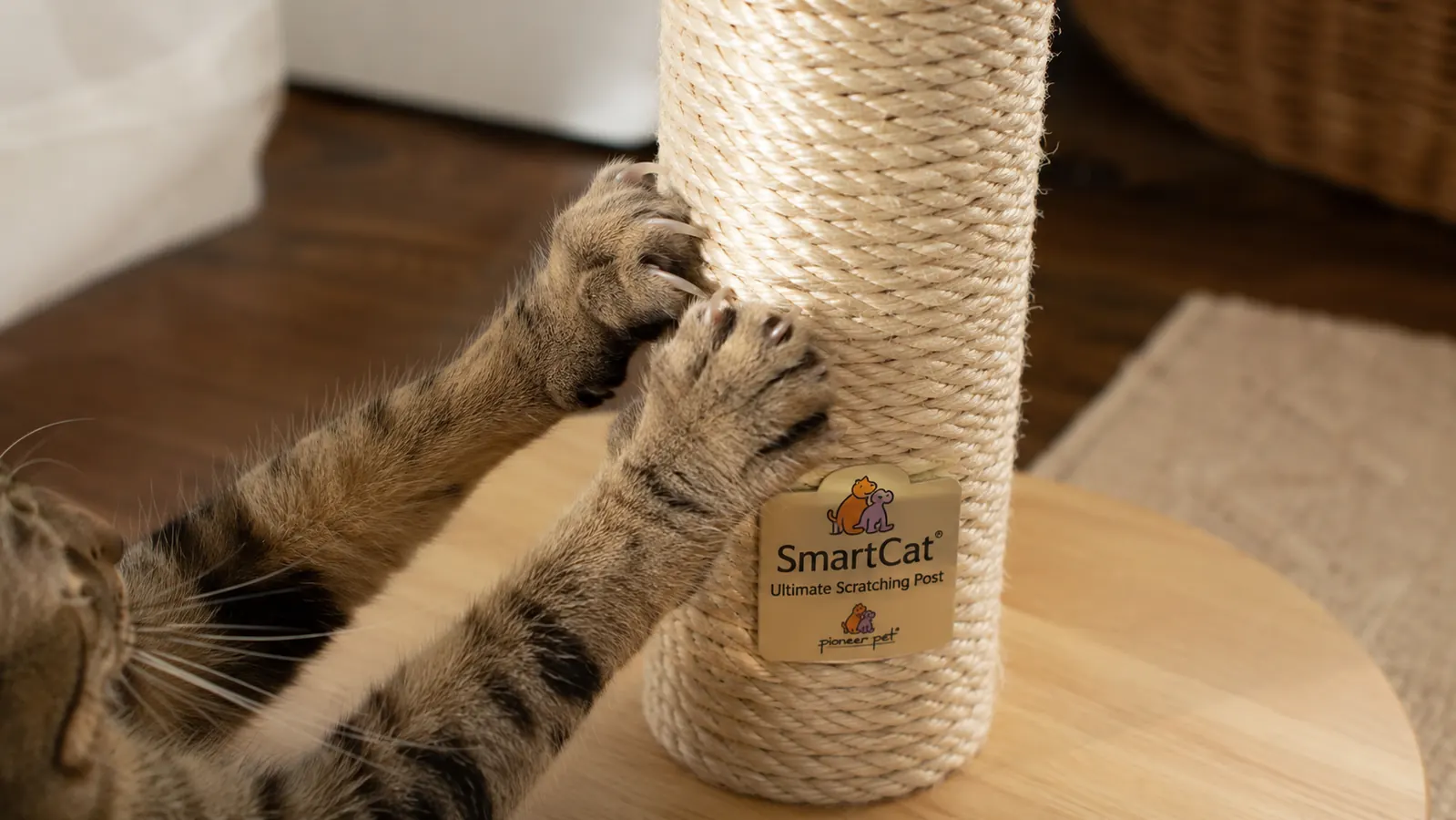
The first thing I learned is that horizontal and vertical scratching solve different problems, and most cheap scratchers only solve the horizontal one. A flat cardboard pad satisfies the claw-sharpening urge, and a cat will use it for a few weeks, and then it stops, because the pad cannot give the thing the cat actually wants: the full-body stretch from shoulder to paw, the same satisfying pull you get hanging off a doorframe.
A cat scratches for three reasons at once. The motion files the dead outer sheath off the claws, the scent glands in the pads leave a little note saying this is mine, and the stretch works a full chain of back and shoulder muscles. Only a tall vertical surface gives all three at full range. Cardboard pads give that stretch about five inches of travel. Thirty-two inches of sisal give a cat the whole arc, and when a cat has that arc, the couch stops being interesting.
Material matters at least as much as height. Sisal rope has a grip that claws can really sink into. Carpet-covered posts are the irony nobody warns you about: to a cat, a carpet post smells and feels exactly like a carpet, which is the very thing you are trying to protect. The SmartCat is sisal top to bottom, and the base is bare natural wood, so the whole object reads to a cat as a tree that someone helpfully brought inside. That is why they prefer it to the couch, not by training but by instinct.
What Six Months of Daily Scratching Looked Like
The stability is the headline, and it is the reason I would not buy a cheaper one again. Juno weighs roughly thirteen pounds and he puts his whole body into a stretch, all of that weight coming down and back on top of the post. That motion is exactly what killed our old post, a cheap carpet-covered tower from a big box store that tipped twice a week and finally shed its wrapping like a mummy coming undone. The SmartCat has never moved. Not tipped, not leaned, not slid on the hardwood. When Juno launches onto it at full speed after a closed door, it takes the impact and stays put.
The base does the work and asks for nothing in return. It is one solid slab of natural wood, heavy enough that I stopped worrying about the whole unit going over, and it sits flat without a wobble even on the slightly uneven floorboards of our rental. No rubber feet to restick, no sand to top up, no hidden annual ritual. In six months I have done exactly nothing to it, and it has done everything I asked. I tested it the way I test a new bread recipe: I changed nothing else for a month, so that when the couch came through whole, I knew exactly which variable to thank.
The real data point is the couch. Before this post I was hand-stitching the arm roughly once a month and losing. Since the second week of February, the arm has been untouched. Not patched, not re-covered, untouched. The cats still walk past the couch dozens of times a day and doze on the back cushions. They just scratch at the post instead, and that single behavior change has now held for six months, which is longer than every other fix we tried put together.
The couch used to lose a sleeve a month. It has been untouched since the second week of February.
The Tradeoffs Nobody Mentions at the Register
First, this is a single post, and its modesty is the point but also the catch. There is no platform, no dangling toy, no perch, no hammock. Cats who climb will still want to climb, so if your cat's whole personality is vertical real estate, they will use the post and then scale the bookcase anyway. For our living room, one tall honest post was the right trade. For a confident climber, a tree with platforms is the honest answer, and that comparison is the one I keep reaching for in reviews like this.
Second, the base is bare natural wood, and it is not trying to be interior decoration. It looks like a very well-made piece of yard furniture, which I happen to love and my sister-in-law with the beige-on-beige living room would want in a closet. If every object in your place has to match, this post will stand out on purpose, and that is worth knowing before you check out. It is handsome, and it is not invisible.
Third, sisal works exactly as designed, which means it wears. The spot where all three cats dig in has gone from rough to smooth, and there is a little fluff on the floor near the top where claws get the most purchase. It is cosmetic, and after six months it is still nothing. But natural rope is not immortal, and somewhere in year two or three this post will show its age. Nobody at the register told me that, so I am telling you now.
What Else We Tried Along the Way
We started with flat cardboard scratch pads, and they were wonderful for about a month. Biscuit worked hers over like a beaver. Then the novelty wore off, the pads became very expensive places for a cat to nap, and the couch became the scratch pad again. That is how I learned that horizontal pads only satisfy half the instinct, and half is exactly as useful as it sounds.
The carpet-covered post we owned before this one was the object lesson. The carpet invited exactly the behavior we were trying to prevent, the base wobbled, and the whole thing tipped over so often that Juno started knocking it down on purpose, because a cat will absolutely turn a design flaw into a game. We also tried catnip spray and double-sided tape on the couch arm. The tape worked until it peeled, and the spray worked until it dried. Every one of those fixes worked on the first Tuesday and failed on the second.
And yes, we debated a full cat tree. The comparison is a fair one, and the honest difference is the floor it takes. A tree gives you the post plus a platform and a perch up top, which is more fun for a cat and more money for you. In a two-bedroom where every flat surface already belongs to a cat, one tall post was the trade we could actually live with. If you have the empty corner, the tree wins on entertainment. If you need the couch protected and the floor kept free, the post wins on honesty.
What I Liked
- 32-inch height lets even a big cat get a full vertical stretch
- Solid natural wood base that has never tipped, wobbled, or slid in six months
- Real sisal rope a cat prefers over carpet, so the furniture stops being the target
- No tools, no assembly drama, and nothing mechanical to break
- All three cats, aged three to eleven, use it daily without any prompting
Where It Falls Short
- A single bare post with no platform, toy, or perch for cats who want to climb
- Bare wood base is handsome but not a match for every living room
- Sisal wears at the spots they dig in hardest and leaves some fluff
- Costs more than carpet-covered towers, and you do feel the difference
- Only works if you place it where your cat already scratches
Who This Is For
If your cats stretch up the arm of a couch, the back of a chair, or the edge of a doorframe, this post is aimed straight at them. It is for renters protecting a deposit, for apartments where a full cat tree is too much furniture, for multi-cat homes where one sturdy post beats three wobbly ones, and for anyone tired of re-buying cardboard pads that get used for a month and abandoned. It is also for people like me who want the first fix they buy to be the last one they need. If that sounds like your house, the SmartCat has held up longer and steadier than anything else I have tried, and it is the recommendation I am most comfortable making.
Who Should Skip It
Skip it if your cat is a strict horizontal scratcher who rubs the floor flat-footed and will not stand up for anything, because a vertical post will be a very expensive doorstop. Skip it if what you actually want is climbing real estate, because then you want a tree, and a post will just leave you both frustrated. Skip it if you will not do the five-minute job of placing it next to the thing your cat already scratches; a post in the farthest corner of the house is decor with a price tag. And skip it if the look of bare wood offends you so much that you would hide the solution rather than use it.
Six Months In, the Cats Still Choose the Post
No tape, no spray, no monthly re-upholstery. The SmartCat post survives the cats, and the couch survives it too. If your furniture could use that kind of peace, check today's price on Amazon and find it a corner.
Amazon Check Today's Price on Amazon →