
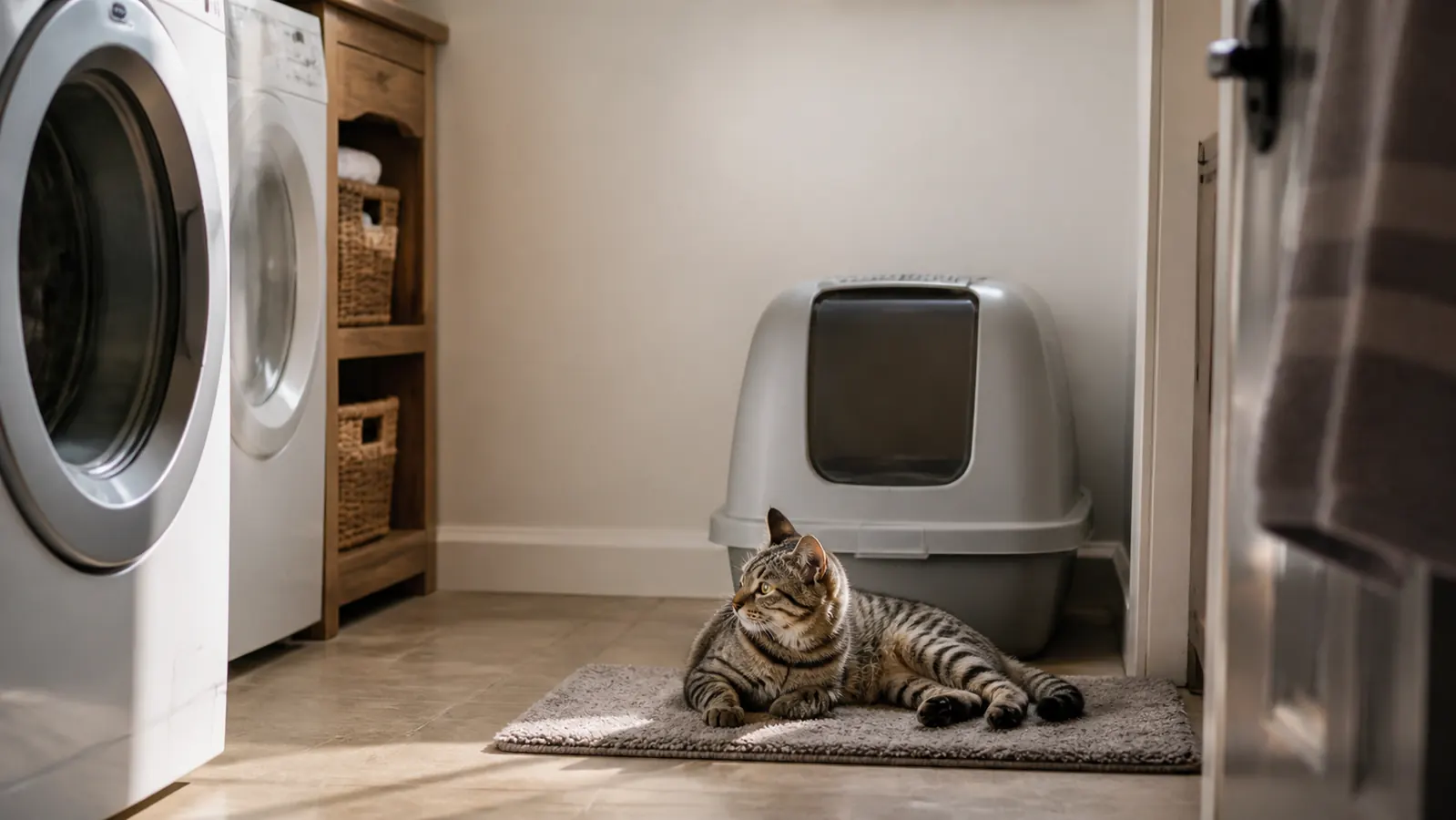
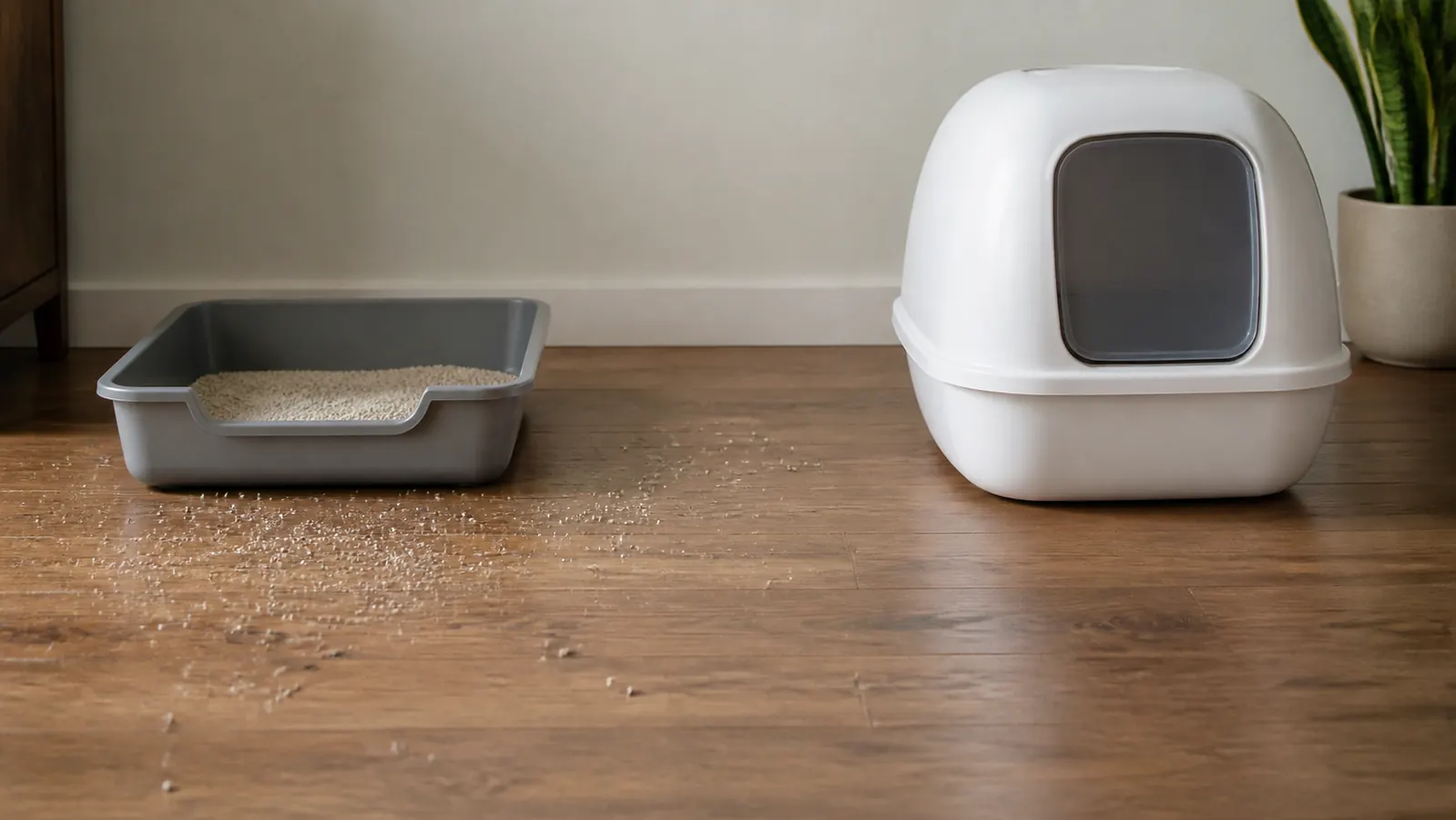
If you have ever scooped an open litter tray and spent the rest of the day finding sand-colored granules in the kitchen, the bathroom, and somehow the couch, you already know why I drive a hooded box now. I spent years as an open-tray person. I grew up with dogs, so the whole idea of a covered potty for an animal felt fussy to me, like something a boutique pet catalog dreamed up to justify selling a covered potty. Then I moved three cats into a small apartment and learned the hard way that my opinion did not matter. By week two I was sweeping the hallway twice a day and guests were asking, very politely, whether we had checked the vents.
Here is the honest short answer. The Amazon Basics No-Mess hooded box beats an open tray on odor control and litter tracking, and in a small or shared space it wins by a wide margin. The trade is that some cats refuse a swinging door, and you trade a five-second scoop for a lid and a door that each need their own wipe-down. For my house the trade was worth it. This is how the two really stack up after six months of running that box as my main setup and keeping a bare tray as backup.
Hooded vs Open at a Glance
| Enclosed Litter Box | Open Litter Box | |
|---|---|---|
| Odor control | Hood traps odor behind the lid, a real difference in a closed room | Smells rise straight into the room between scoops |
| Litter tracking | High walls plus the hood keep most granules inside | Granules get kicked across the floor on every use |
| Privacy for the cat | Covered on all sides, shy cats feel hidden | Fully exposed, some cats feel vulnerable |
| Cleaning | Lid and door need a weekly wipe-down on top of scooping | Quick to scoop, nothing extra to manage |
| Door and entry | Swinging door you can prop open or remove when a cat resists | Fully open, no entry barrier at all |
| Cost | More upfront, a bigger investment | Cheaper to buy and simple to replace |
| Best for | Small homes, apartments, shared spaces, multi-cat homes | Easy-access setups, senior or very large cats, tight budgets |
Sick of finding litter in your coffee mug?
If you are scooping an open tray and chasing granules all day, the Amazon Basics No-Mess hooded box contains the scatter and keeps the odor behind a lid. After three cats and six months, it is the fix that gave my hallway back.
Amazon Check Today's Price on Amazon →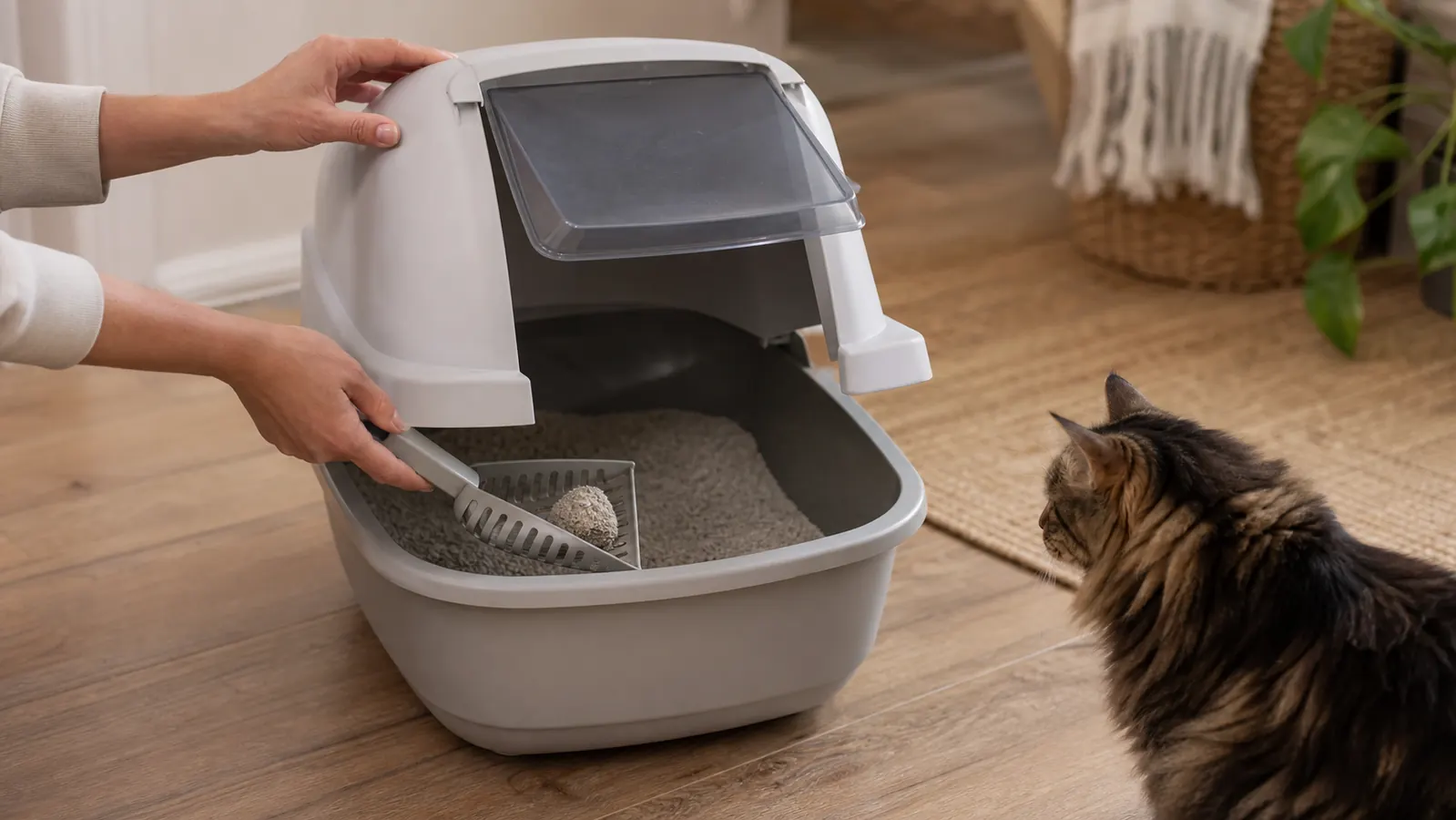
Where the Hooded Box Wins
The biggest difference is odor, full stop. An open tray does nothing between scoops. Whatever your cat just buried is sitting there, breathing straight into the room. A hooded box traps that air behind the lid and at least slows the whole process down. In the small apartment I live in, that change was immediate and repeatable. I still scoop every day, but the room no longer smells like a litter box by four in the afternoon. People who walked in could never quite place what had changed. They just stopped glancing at the corner where the box lives.
The second win is scatter, and this is the one I felt in my legs. My cats are enthusiastic diggers, and Gus in particular treats any open tray like the beach at low tide. With a bare tray, granules and dust flew a full foot past the mat and settled into the hallway. The Amazon Basics box has high walls on top of the hood, so most of the digging stays inside. I went from sweeping twice a day to once a week, and the rare granule that does escape lands on the mat instead of the baseboards. In a small space this is the difference between a tidy home and living inside a litter box.
The third reason I kept it is harder to measure but just as real: the box cuts the ambient cat scent that settles into towels, curtains, and the mat over a day. Three cats in one small bathroom put a lot of odor molecules into that room, and the open tray let the freshest, strongest part of it drift straight out. The hood does not erase that background smell, but it keeps the most concentrated part of the litter contained, so the room starts from a much cleaner baseline. After I switched, the bathroom stopped announcing itself the moment you opened the door, no matter how the afternoon went.
Three cats in one bathroom, and nobody could tell a litter box lived there by the end of the day. That was the moment I stopped treating the hood as a gimmick.
Where an Open Tray Wins
Here is the honest side, because a hooded box is not a universal winner. The biggest issue is cat acceptance. Some cats simply will not walk through a swinging door, and no amount of patience fixes that. One of my three, a nervous little gray cat named Pip, needed almost two weeks of me propping the door open with a folded hand towel before she would go in. A cat that refuses a covered box is a cat that pees on your rug, and that is a far worse trade than a bit of litter scatter. If you have a senior cat, arthritis can make a swinging door and a covered entry genuinely uncomfortable to push through.
The other thing nobody tells you is that the lid gets dirty. You trade the five-second open-tray scoop for a hood that collects dust, kicked granules, and the occasional miss where the lid meets the base. My Amazon Basics box needs a proper wipe-down of the lid and the door about once a week, on top of daily scooping. It is not hard work, and it takes under five minutes, but it is more work than a bare tray. The person who just wants the absolute easiest box to maintain will find the open tray simpler, and I respect that choice.
I went from sweeping the hallway twice a day to once a week. That single change is the whole reason the hooded box still has my vote.
The Size Question Nobody Talks About
Before you buy any hooded box, measure your cat before you measure your room. A hooded box eats a lot of interior floor space because of the walls and the lid, so a large or long-bodied cat can feel cramped inside even when the box looks big on the outside. My biggest cat, Mabel, is a 12-pound long-bodied tabby, and the Amazon Basics box at about 25 inches long is snug but workable for her. If your cat is closer to 16 pounds or on the lanky side, look at the larger sizes before you commit, because a covered box that is too small is a box a cat stops using.
The good news is that the exterior footprint is still smaller than you might fear, and the hood means there is nothing left hanging open to take up visual space in a tight corner. A hooded box tucks into a laundry room or a bathroom nook far more neatly than a bare tray of the same usable area, because the tray's open top leaves the whole thing exposed while the hooded box reads as a tidy little cabinet. That has been a genuine bonus in my small place.
One placement tip that made a real difference: keep the hooded box away from a wall on at least two sides. An open tray can sit flush in a corner, but a box with a swinging door needs a little room in front for the door to swing and for a cat to turn around inside. I originally wedged mine tight against the washer, and Gus kept bumping his head on the lid when he backed out. Once I gave the front a few extra inches of floor, both he and Pip stopped hesitating on the way in. That one adjustment took me a week to figure out.
What Daily Cleaning Really Looks Like
Let me walk you through the real routine, because a lot of what people assume about hooded boxes comes from never owning one. Mine takes the same two scoops a day that the old tray did, once in the morning and once after dinner. The difference is that I reach through the door or lift the top lid instead of leaning over a fully open pan, and honestly that is more pleasant, not less. There is no freed dust cloud drifting into my face while I work, and the granules stay confined to the box instead of raining onto the floor beside it.
The extra step is weekly: I pop the lid off, wipe the inside of the hood and the base rim where kicked litter collects, and give the swinging door a quick rinse. That takes under five minutes. I do a full dump and wash of the whole box every two to three weeks, which is about the same as I did with the open tray. So the honest summary is that daily life gets easier because there is no scatter to chase, and weekly life gets slightly longer because of the lid. I will take that trade every time, and not just because I am tired of sweeping.
With three cats, the open tray also meant three cats were burying three sets of daily business in one exposed pan, which is why the smell felt so front-loaded by the end of the day. The hooded box does not change how often I scoop, but it changes how the room smells between scoops in a way that is a lot more forgiving in a one-bathroom apartment. That is the difference that made the box feel worth it within the first month, before any of the long-haul conveniences had a chance to matter.
One small thing I did not expect was how much quieter the room feels. With the open tray, the loud raspy sounds of digging carried through the whole apartment, and my cats scratched at the plastic in a way that set my teeth on edge. The hood muffles most of that. The box is not silent, but the noise stays closer to the corner where it happens instead of bouncing off every wall. On a bad day with three enthusiastic diggers, that is a nicer thing than I thought it would be.
Who Should Buy Which
Buy the hooded box if you live in an apartment or a small house, if you share space with guests, roommates, or a landlord's nose, or if your cats are adventurous diggers who fling litter everywhere. That is exactly my situation, and the Amazon Basics No-Mess box solved it. It is also worth it if you have a shy cat who would rather feel covered while they do their business, which is a real instinct in animals, not a decoration thing.
Buy an open tray if you have a senior cat, an extra-large cat, or a cat that has already refused a covered entry. If a simple lid is the one thing standing between you and a clean rug, skip the hood entirely and save yourself the drama. An open tray is also the smarter pick on a tight budget, since a basic pan costs a fraction of what the larger enclosed boxes run and there is nothing extra to break or replace.
One more thing worth knowing: the door comes off entirely. If your cat decides the swinging door is the enemy, you can pop it out and run the hooded box as an open-topped box while the high walls still contain the scatter. That is the fallback that saved my first month with Pip. It is a middle ground no open tray offers, and it means you are not stuck with a box your cat refuses to use.
One honest note on cost before you decide. A hooded box costs more up front than a basic open pan, and you should budget for that difference. But I replaced cheap open pans more than once as cracks formed and corners chipped, while this heavier Amazon Basics box has held its frame through six months of daily use without giving up. For the extra money I got a box that contains smell and scatter instead of a tray that eventually leaks both. It is a real trade, and there is no wrong answer as long as the cat keeps using whichever one you pick.
My rule of thumb is simple. Fix the smell and the mess for the humans, but never at the cost of a cat that will not use the box. The Amazon Basics hooded box gave me both the odor control and the containment, and after three cats, six months, and a lot fewer trips to the vacuum closet, it earned its spot in the corner. If your open tray is making the whole house smell like the zoo, that is a problem worth solving today. Just keep the door propped open for the first week while everybody figures it out.
Ready to get your hallway back?
The Amazon Basics No-Mess hooded box contains the litter, holds the odor, and survived six months of three cats treating it like a small fortress. Check today's price and see whether it fits your corner.
Amazon Check Today's Price on Amazon →