
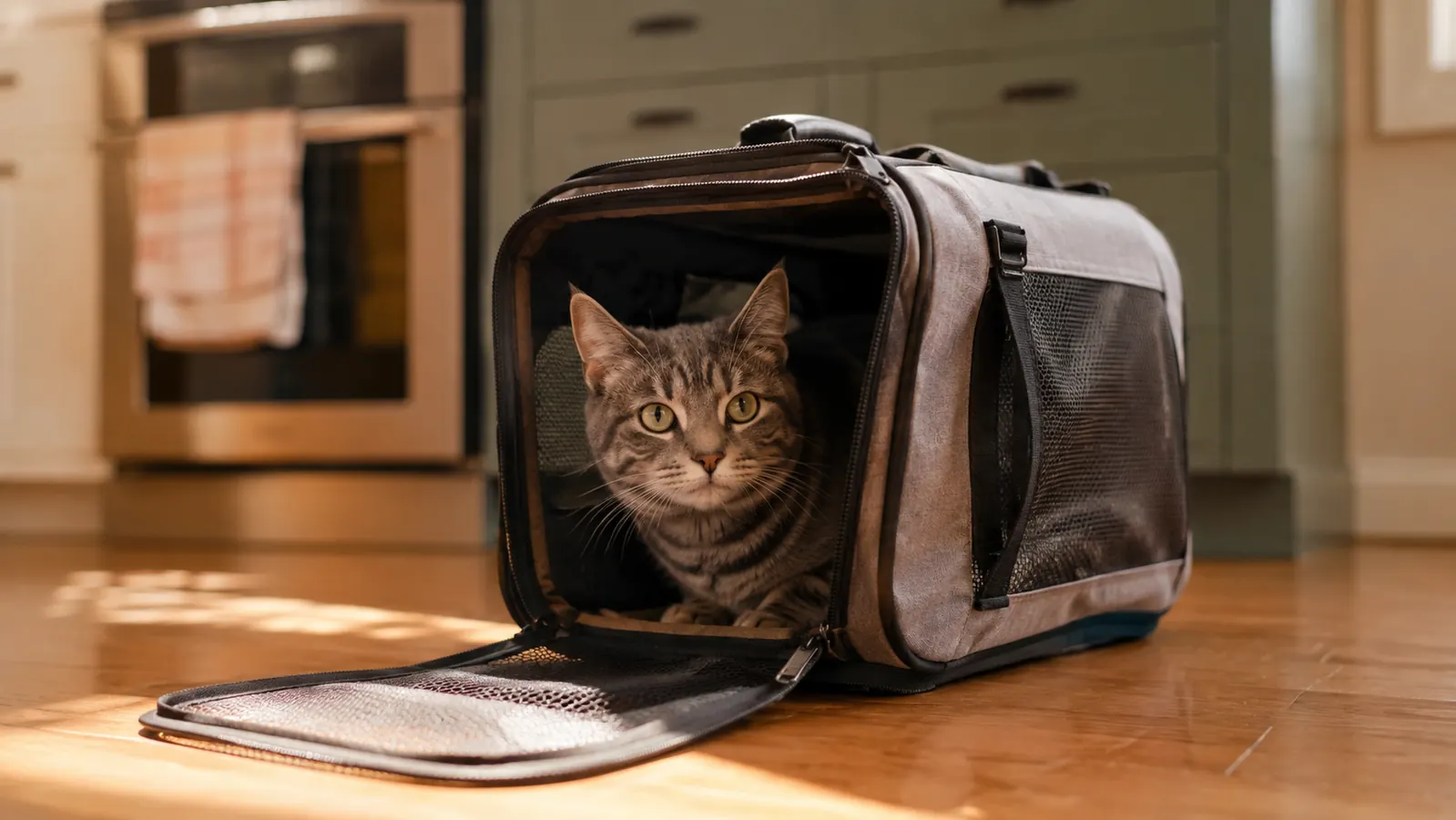
Every animal person I know has a version of the first time they tried to get a cat into a carrier. Mine involved Mabel, my nine year old gray tabby, the 8:15 vet, and a carrier I had to disassemble from under the couch after she wedged herself behind it backward. I grew up with dogs, so I treated a carrier the way dog people treat a crate: a piece of gear you grab and go. Cats do not work that way, and it took me longer than it should have to understand why. Six months and a dozen trips later, I have finally stopped treating the carrier as a wrestling prop and started treating it as an actual piece of equipment worth thinking about. This is the long version of what that looked like with the Henkelion soft-sided carrier, the good parts and the parts that gnaw at me.
The Quick Verdict
For a nervous cat that hates the ride, the open-top zip panel and soft sides turned our vet trips from a series of small rescues into something close to routine, and it is the carrier Mabel no longer treats as a hidden enemy.
Amazon Check Today's Price →Six months of trips, one carrier that finally stopped the escape attempts
If you are still dragging a hard plastic box out from under the bed and dreading the zipper fight, this is the carrier that changed it for us. It is the one I reach for every single visit now.
Amazon Check Today's Price on Amazon →How I've Used It
Let me set the scene honestly, because descriptions of cat gear tend to skip the mess. Three cats share my house: Juniper, a five year old tuxedo who weighs eleven pounds and has never met a suspicion she didn't embrace; Pip, a chunky orange who is three and thinks every human lap is his personal property; and Mabel, the nine year old tabby who is the actual reason I started shopping for a carrier instead of just tolerating the one we had. Mabel gets a urinary checkup that requires a visit roughly every three months, and for years that meant a morning of hunting her down, thirty minutes of coaxing, and a ride where she cried the whole way in a broken key.
In the six months I have owned the Henkelion, I have used it for four vet visits for Mabel, two visits for Juniper's annual bloodwork, a five hour road trip to my sister's farm, and one airport run on the subway when a friend borrowed it for her kitten. So that is seven real trips plus the airport loan, not counting the dozens of times I have left it out on the floor as furniture so the cats could get used to it. It carries up to fifteen pounds, which covers all three of mine comfortably since my largest, Pip, is fourteen.
The single biggest change was the top opening. That is the part I underestimated before I bought it, and it is the part I would not give up now. With the old hard-sided box, getting Mabel in meant turning her upside down and lowering her in feet first, which she correctly interpreted as an ambush. With a top zip panel that opens the whole roof, I set the carrier on the floor, lift her in from above, and close it before she has time to file a complaint. It reads as a much smaller betrayal. The difference in her heart rate between the two methods is something I can feel through her chest, and it is night and day.
What Four Real Vet Visits Looked Like
The first visit with the Henkelion was Mabel's three month urinary check, and I expected the old routine, so I blocked off the whole morning. Instead I unzipped the top, she walked in, and I carried her four blocks to the clinic with her sitting perfectly calm. The vet noticed. The clinic notes for that visit say she presented calm, and that is a sentence I have never once seen written about Mabel in nine years. The second visit I slipped back into my old habits and left the carrier out too late, and she still got in, just with more attitude and a warning look; that one needed the full towel treatment and a longer quiet spell in the waiting room. By the third and fourth visits, my own calm had caught up with the gear, which is half the battle with a nervous cat. A cat reads your hands, and once I stopped bracing for a fight, the fight mostly stopped happening.
Here is the detail that surprised me most. Mabel does not just tolerate the carrier now, she chooses it. On quiet evenings when the office floor is warm, I will find her asleep inside it with the top open, the same bag that used to mean a trip to the vet she hates. That is the behavior to watch for when you are deciding whether a carrier is actually working: a cat who naps in the box has stopped filing it under threat. Juniper, the tuxedo who has never met a suspicion she did not embrace, still eyes it warily, but even she will sit in it when there is a towel inside.
Why the Soft-Sided Design Won Me Over
Here is where I have to correct myself, and I say this as someone who grew up with dogs and used to swear by hard plastic because it seemed more rugged. The soft-sided carrier gives on every edge, and that flex is the whole point. When Mabel shifts mid-ride, the walls give a little instead of banging her ribs against a solid shell. When I carry it down the front steps, the weight settles into my hip instead of swinging around like a rigid suitcase. My sister, who has had hard crates her whole life, watched me carry Mabel in the Henkelion across the farm yard at the end of our road trip and asked, with real confusion, whether it felt safe. It does, and here is why: the frame is still the firm part, around the base and the corners, so the bag holds its shape and keeps the cat from being squeezed. Only the panels flex. You get the security of a box and the give of a saddlebag at the same time.
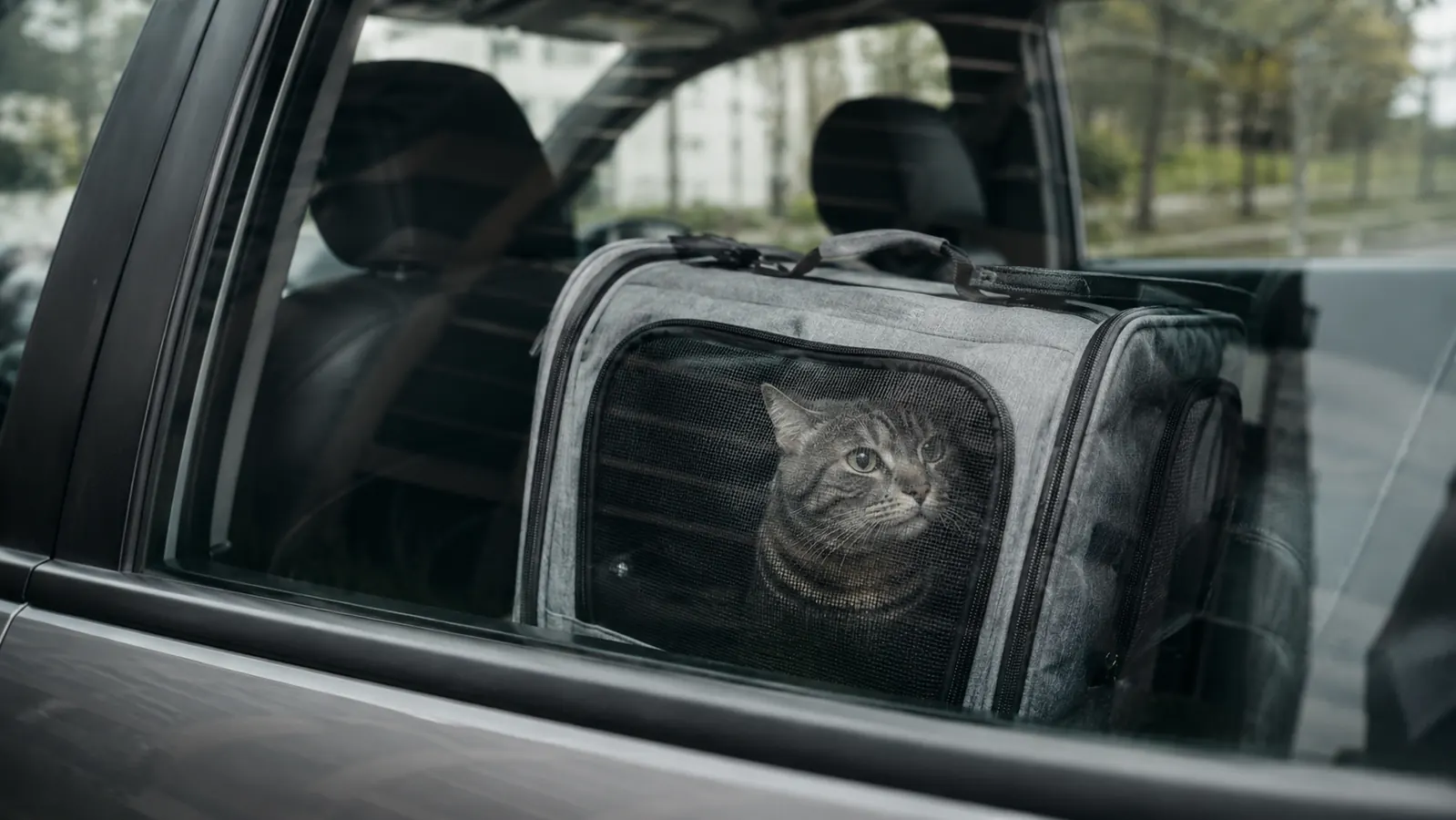
The mesh is the part I inspect every time I clean it, because a nervous cat's only real weapon in a carrier is a seam. Six months in, after seven trips and Mabel's full panic repertoire, every seam is intact. The zippers on the top and the two side doors all still run smooth, and the buckles on the strap that clips her harness to the inside ring have held. I clip Mabel's harness to that ring on every ride, which is the piece of advice I would give anyone: the soft-sided walls have give, so the tether is what keeps a panicking cat from pushing her head out through the gap where the zippers meet. One of my very first uses of it, I forgot the tether and watched her nose work its way into that corner. It closed the trick, but it taught me the habit. Tether first, always.
The open-top zip panel is the difference between lifting Mabel in and wrestling her in, and after six months I would not buy another carrier without one.
The Calm-Down Trick That Changed Everything
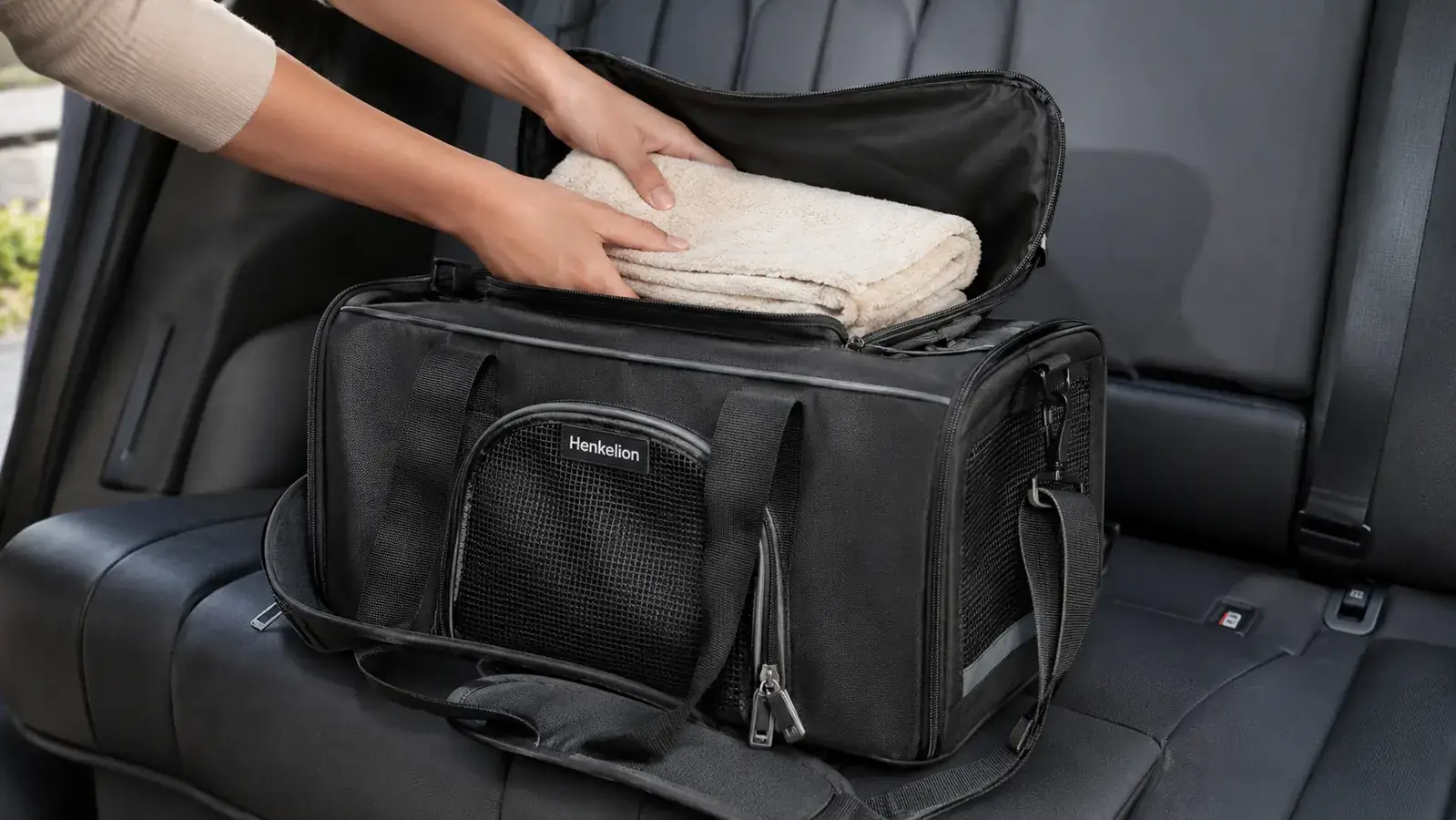
The soft sides do more than feel nicer, they gave me room to manage the ride, which is something a hard box simply does not allow. Early on I started putting a folded towel over the top and one side of the carrier during the car ride. On Mabel, a covered carrier reduces the motion she can see, and she goes from crying to quiet within about five minutes. With the old hard plastic box, I could not get a towel to stay over that shape, let alone reach in to adjust her bedding mid-ride through an open top. With the Henkelion, I can unzip the top a few inches at a rest stop, swap out a damp towel, and zip it back without releasing her. That sounds like a small thing until you have done it on a long trip and watched a cat go from miserable to napping.
And because I am the sort of person who makes her own bath salts and generalizes that hands-on instinct to the animals in her care, I built her a little routine around the carrier that I think is worth passing on. It lives out on the floor of my office with the top open and an old T-shirt of mine inside, all month, not just on vet days. By the time a visit rolls around, Mabel has claimed it as a nap spot on her own terms a dozen times. The vet trip then becomes a case of her sitting in her own bed, not being herded into a trap. It does not fix everything, nothing does with a nervous cat, but it cuts the worst of the pre-ride panic in half.
Cleaning, Car Rides, and the Daily Grind
Here is where the soft-sided carrier asks you to do a little more than a hard box, and I want to be straight about that. The removable liner is what saves it. On the ride home from the airport loan, Jodie's kitten got carsick and the liner took the whole mess. I pulled it out, ran it through the wash with a bit of enzyme cleaner, and it came out looking like nothing had happened. But if you buy this carrier expecting a hard box you can just hose out, you will be disappointed. The main body is not machine washable beyond spot cleaning, and the padding does not come apart for a deep soak. So the liners carry the load, and as long as you keep a spare, cleaning is genuinely easy. If you do not have a spare liner, cleaning day is a more fiddly afternoon than a plastic box would hand you.
The weight is the other thing that keeps surprising me. My old hard carrier was light but it carried badly, hanging off one hand like a bucket. The Henkelion has a padded top handle and an over the shoulder strap, and because the bag is collapsible it is not fighting me when I walk. For the subway run to the airport, that shoulder strap meant the difference between a manageable trip and a two-handed wrestling match. The collapsible part also means it folds flat and tucks behind the couch when we are not in a travel season, which my small apartment deeply appreciates.
What I Liked
- Open-top zip panel lets you lift a cat in from above instead of wrestling it in headfirst, which is the single biggest de-stressor
- Soft-sided walls give and absorb motion, so rides are noticeably calmer and carrying it is more comfortable
- Two side doors, top opening, and a back compartment give plenty of ways to get to your cat
- Removable, machine-washable liner makes the messy cleanups manageable
- Collapsible and light enough to carry one-handed or over the shoulder
- Collapses flat for easy storage in a small home
Where It Falls Short
- Main body is spot-clean only, so you need a spare liner (or the second one that ships with it) for the big messes
- Soft sides demand a harness tether on nervous cats, because a determined cat can push at the zipper corner gaps
- At fifteen pounds max it will not fit a very large cat, and some chunky cats are a tight squeeze
- Not the right pick for airlines that require rigid, crash-tested hard carriers
- Padding does not come apart for a deep soak
The Honest Tradeoffs That Ate at Me
I do not want to oversell this, because I promised to be straight. The soft sides buy calm and comfort, and they give back a little in certainty. With a hard box, what you carry is a rigid shell you never have to think about. With this carrier, I check the zippers before every trip, I keep the tether habit, and I am careful about how I set it down, because a soft bag does not protect itself the way plastic does. None of that has ever caused a problem in six months, but it is more attention than a hard box asks for. If the idea of maintaining a fabric carrier irritates you, that maintenance is the honest tax you pay for the calm, and it is worth naming clearly.
The fifteen pound limit is real and it is the one spec I keep circling. My orange Pip is fourteen and he fits, but there is not a lot of spare room, and he is a patient cat to boot. A larger, rounder cat at the top of the carrier's stated range is going to be squeezed, and a cramped cat is a stressed cat, which defeats the entire point of buying a soft carrier for calm. If your cat is over the limit or even near the top edge, measure the interior before you buy, and be honest with yourself about whether we are talking about a quick vet run or a long drive where the cat will live in the bag for hours. That single number does more to decide whether this carrier suits you than any other feature on the listing.
Who This Is For
Buy the Henkelion if you have a cat who fights the carrier, because the top opening fixes the worst part of the fight. Buy it if you do road trips, because the soft sides and the shoulder strap make long rides genuinely kinder for everyone, cat included. Buy it if you live in a small place and need gear that stores flat between uses. And buy it if your vet visits are close to home and fairly routine, because for everyday handling and calm, this is the best carrier I have used, and I have used a ridiculous number of them across a house with three cats and a friend whose kitten needed a loan for an airport run.
Who Should Skip It
If you fly commercially with your cat, check your airline first, because several require a rigid, airline-approved hard carrier for the cabin, and the soft-sided bag will not make the cut. If you have a cat over roughly fifteen pounds, get out the measuring tape before you order, because my fourteen pound orange is near the top of the range and a bigger cat is going to be a tight squeeze. And if your cat is a dedicated chewer or clawer who has destroyed every soft thing they have touched, the mesh panels will have a harder life than a hard shell would. There is a place for a rigid carrier, and if your situation is a panicked cat in a long drive through rough roads or a picky airline, that is the corner it should keep.
The Alternatives I Considered
I almost bought a hard-sided carrier again out of habit, because it is what dog people reach for and I grew up reaching for it. I also weighed a cheaper fabric bag with no top opening, and the one thing that pushed me to spend a little more was exactly that roof panel. You can read the full breakdown of how the soft-sided carrier stacks up against a hard crate in my comparison, and it comes down to this: for the kind of vet-and-carrier life most of us actually live, soft-sided wins on peace, and hard wins on unbreakable security and airline rules. If your worry is the daily trip and the calm, soft-sided is the one.
The carrier that turned our vet days from a rescue into a routine
Six months of trips, four vet visits, one road trip, and a carrier Mabel now naps in on her own. If every carrier you own has become a wrestling prop, this is the one worth switching to.
Amazon Check Today's Price on Amazon →